The following is abstracted from reference [1] and the Gideon web application www.GideonOnline.com . Primary references are available on request.
Schistosomiasis was first reported in the Philippines in 1906, and as of 1921, an estimated 25,000 to 30,000 people were infested. During 1944 to 1945, 1,700 cases were reported among American and Australian military personnel serving in the Philippines.
An estimated 300,000 Filipinos were infested as of 1948. By 1970, the disease was known to be epidemic to 24 provinces.; and as of 1975, 5 million persons were considered at risk and approximately 1 million infected. By 2002, an estimated 800,000 were infested and 6.7 million at risk; and as of 2010, an estimated 560,000 were infested.
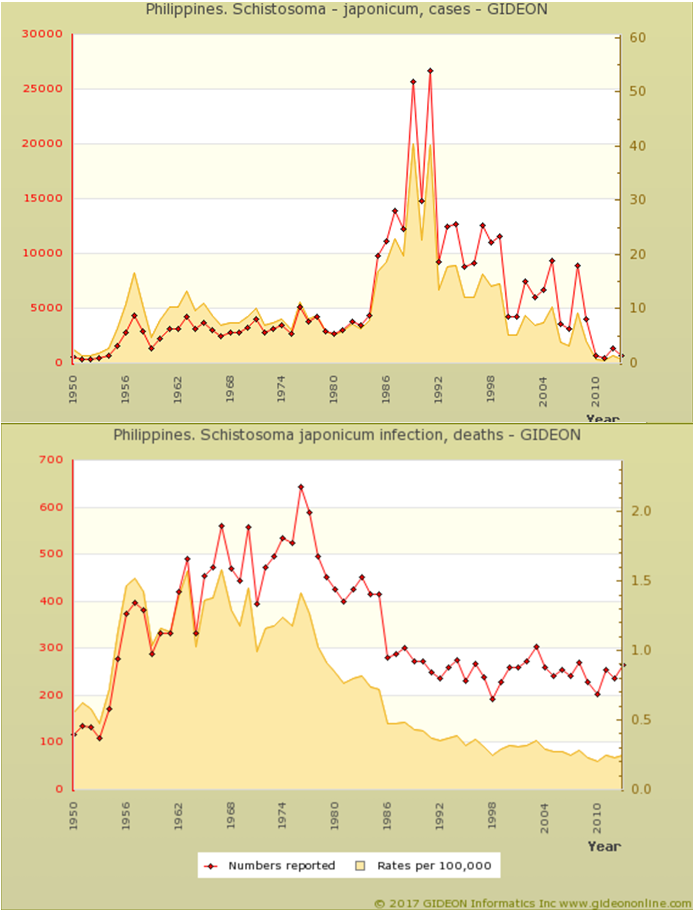
Reported incidence and mortality data are summarized in the following graph:
In recent years, cases have been reported from Mindoro Oriental and Sorsogon in Southern Luzon; the provinces of North, East and Western Samar; Leyte; Bohol in Eastern Visayas; all of Mindanao with the exception of Misamis Oriental, Davao Oriental and Maguindanao.
Schistosomiasis is most common among males, and individuals ages > 19 years.
Notable outbreaks were reported in Davao del Sur in 2000 (222 cases as of October – most in Digos- Igpit, Colorado, and Matti barangays); and in Palo, Leyte in 2011 (99 cases)
Infestation by Schistoma japonicum is common among dogs, field water buffaloes (Carabao) and rats on Leyte. The local snail reservoir is Oncomelania hupensis quadrasi .
Reference:
- Berger S. Infectious Diseases of the Philippines, 2017. 342 pages, 93 graphs, 1,035 references. Gideon Informatics
 This GIDEON website is now available at