GIDEON blog

Free Demo ► Latest Updates ► Video Tutorials ►
Subscribe , j x

Salmonellosis in Spain

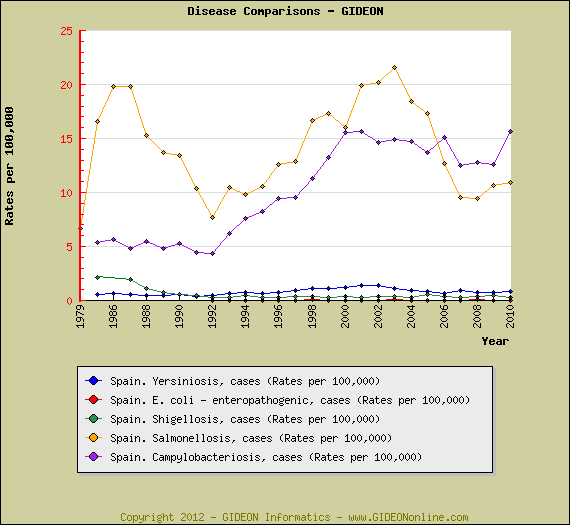
Rates of salmonellosis in Spain have followed an undulating pattern for over 30 years, and are similar to those of campylobacteriosis (see graph) [1-3] In the following table, I’ve summarized published studies of the prevalence of Salmonella in this country. Primary references are available on request.

Prevalence surveys:
10.2% of patients with gastroenteritis (Madrid, 1980 to 1983)
29.4% of bacterial gastroenteritis cases in adults (2007 publication)
41% of gastroenteritis outbreaks with known etiology in Catalonia (2006)
84% of all food-related outbreaks reported during 1990 to 1992
65.7% of food poisoning outbreaks in the Basque Autonomous Community during 1984 to 1986
31.1% of childhood (ages 1 month to 14 years) gastroenteritis requiring hospitalization in Girona (2007 publication)
5.1% of children (<5 years) admitted for gastroenteritis to a hospital in Albacete (2005 to 2008) 4% of diarrhea among children seen at an emergency room in Valencia (2005) 10% of ovine flocks in northern Spain (1999 to 2003) 2.9% of free-ranging poultry farms in the Basque country (2007 publication) 0% of greater flamingo (Phoenicopterus ruber roseus) chicks in the Ebro Delta (2010) 1.3% of retail fruit and vegetable samples in Lleida (Catalonia, 2005 to 2006) 1.2% of smoked salmon samples, 1.5% of frozen chicken croquettes, 2% of cooked ham samples, and 11.1% of cured dried sausage samples (Barcelona, 2008 publication) 23.7% of raw materials and 0% of final product at factories manufacturing fuet (traditional fermented sausage, 2011 publication) 0% of home-made tiger nut beverages in Valencia (2012 publication) References: 1. Berger SA. Infectious Diseases of Spain, 2012. 557 pages, 194 graphs, 2850 references. Gideon e-books, https://www.gideononline.com/ebooks/country/infectious-diseases-of-spain/
2. Berger SA. Salmonellosis: Global Status, 2012. 252 pages, 300 graphs, 2297 references. Gideon e-books, https://www.gideononline.com/ebooks/disease/salmonellosis-global-status/
3. Gideon Graph Tool at https://www.gideononline.com/wp-content/uploads/Gideon-Graphs.pps

Bat Rabies in Europe

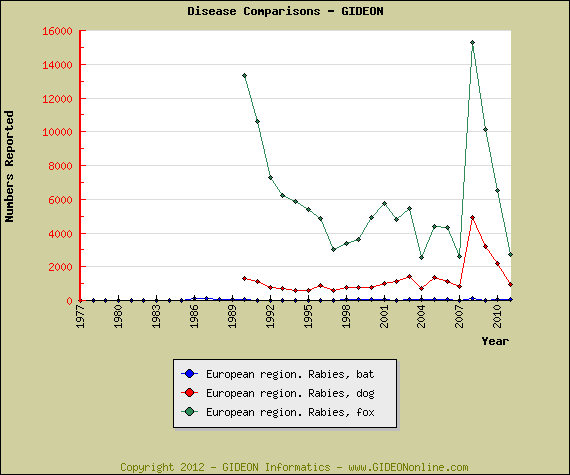
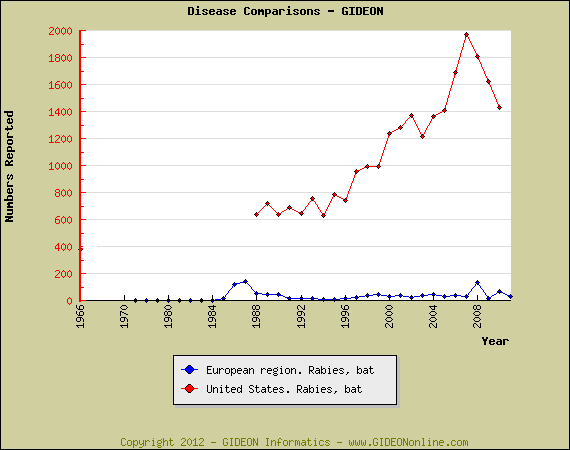
I suspect that reporting of bat rabies in Europe is reliable, given the major impact of this disease and relatively high quality of surveillance in the region. Parallel reporting of bat rabies in the United States and of fox/dog rabies in Europe suggest that bat rabies is a rare phenomenon in Europe. In the following graphs, I’ve contrasted relevant data:

Hepatitis E in India

The following data regarding Hepatitis E in India are abstracted from Gideon www.GideonOnline.com and the Gideon e-book series. [1,2] Primary references are available on request.

The incidence of Hepatitis E in India is estimated at two million cases per year.

Prevalence surveys:
60% of sporadic hepatitis in India (over 70% of acute hepatitis among children), with most reports from the north and western regions.
58.3% of pregnant women with acute viral hepatitis, 41.4% of hepatitis patients with fulminant hepatic failure, 53% with chronic liver disease (northern India, 2011 publication)
32.5% of non-A acute viral hepatitis in Tamil Nadu and Andhra Pradesh (1996).
53.3% of sporadic acute hepatitis cases diagnosed in-hospital in Delhi during 1996 to 1997
29.08% of viral hepatitis cases, 4.25% of sewage samples and 1.42% of drinking water samples in the Gokulpuri area (2010 publication)
18.9% of acute hepatitis in Bangalore (1997 to 2000)
46.4% of acute hepatitis among children (71.2% among adults) in Pune during 1978 to 1981; 12.2% (42.4% among adults) during 1994 to 1997
75% of acute liver disease among children with ongoing chronic liver disease (Lucknow, 2011 publication) 4
49.6% of acute viral hepatitis in Andaman and Nicobar Islands (2003)
38.6% of acute viral hepatitis in Northern India (2007 publication)
47.4% of acute hepatitis in pregnant women – of which 39.1% were fatal (northern India, 2007 publication) 7
40% of acute hepatitis in pregnant women – 50% to 53% in the second and third trimester presented with fulminant hepatic failure (2011 publication)
0.83% of pig livers in a retail market (Pune, 2008 publication)
41% of sewage samples in Northern India (2004 to 2006)
25% of drinking water samples in Pune (2009 publication)

Seroprevalence surveys:
18% of healthy populations in 1982; 26% in 1992; 4% in 1994; 64% in 1997
5% of healthy adults during 1988 to 1991; 37% in 1995; 50% in 1997
2.9% ages 1 to 5 years in urban southern India, 8.9% ages 6 to 15, 23.6% ages 16 to 25, and 35.5% ages 26 to 40 (1999 to 2000)
33.67% of pregnant women in north India (2009 publication)
4.8% of hospital attendees in Pondicherry (2007 publication)
94.1% of swine handlers in Vellore (2011 publication)
56.5% of sewage workers
18% of hepatitis patients during 1988 to 1991; 11% during 1993 to 1994
25% of adults with hepatitis during 1992 to 1994; 33% in 1996
39% of adults with fulminant hepatitis during 1987 to 1992; 48% during 1992 to 1996
45% of children with fulminant hepatitis during 1993 to 1994
23.8% (urban) to 28.7% (rural) of children ages 6 months to 10 years in Northern India (1996)
5.3% to 16.7% of children ages 6 months to 12 years in urban Chennai (Tamil Nadu, 2003 publication) 26.7% of Indian students living in Poland (2008 publication)
37% of United Nations peacekeepers in India (1998 publication)

Seropositivity rates among animals are as follows: 4.4% to 6.9% in cattle; 54.6% to 74.4% in pigs; 2.1 to 21.5% in rodents; 22.7% in dogs; 0% in goats; 50% in bandicoots (Bandicota bengalensis).

Notable outbreaks:
Sixteen epidemics were recorded in India during 1955 to 1994.
Seven outbreaks were reported in Ahmedabad during 1976 to 2010.
1955 – An outbreak (29,300 cases) of presumed Hepatitis E was reported in New Delhi (the world’s first epidemic) – due to contamination of water which followed flooding of the Yamuna river.
1978 – An outbreak (20,000 cases) was reported in Gulmarg (Kashmir) 23 . Others estimated 52,000 cases of icteric hepatitis and 1,700 deaths.
1979 – An outbreak (6,000 cases) was reported in Sopore (Kashmir).
1981 – An outbreak (1,200 cases) of water-borne non-A, non-B hepatitis was reported in Kolhapur City.
1981 to 1982 – Outbreaks (26,000 cases) were reported in Ardwara and Kupwara (Kashmir).
1984 – An outbreak (3,005 cases) was reported in Baroda.
1987 – Outbreaks were reported in Ahmedabad (2,215 cases) and Delhi.
1988 to 1989 – Outbreaks were reported in Maharashtra.
1989 – An outbreak was reported in Yamunanagar.
1990 – An outbreak (3,000 cases or more) was reported in Beed.
1991 to 1992 – An outbreak (79,091 cases) was reported in Kanpur.
1992 – An outbreak was reported in Delhi.
1994 – An outbreak of enteric non-A, non-B hepatitis was in Jodhpur city, Rajasthan was ascribed to contamination of drinking water by sewage.
1995 (publication year) – An outbreak was reported in an “educated and well placed community” in Delhi. 32
1995 – An outbreak (21 cases) was reported among staff members of the School of Tropical Medicine in Calcutta.
1996 – An outbreak was reported in Meerut.
1998 – An outbreak was reported in Bihar
1999 (publication year) – An outbreak (10 cases) was reported among children on a trekking trip.
2000 (publication year) – An outbreak (77 cases) of Hepatitis A, Hepatitis B, Hepatitis C and Hepatitis E infections was reported in a prison.
2002 – An outbreak (185 cases) was reported at a regimental training center.
2003 – An outbreak (123 cases or more) was reported in Goa.
2004 – An outbreak (800 cases or more) was reported in Dum Dum (West Bengal).
2004 – An outbreak (538 cases) in Baripada, Orissa was associated with an interruption in municipal water treatment.
2005 – An outbreak (93 fatal cases) was reported in Mumbai.
2005 – An outbreak (415 cases) was reported in Maharashtra.
2005 – An outbreak (1,611 cases) in Hyderabad was ascribed to contaminated water.
2005 – An outbreak (205 cases) in Uttarakhand was ascribed to drinking from an unprotected spring.
2005 to 2006 – An outbreak (3,170 cases, 18 fatal) was reported in Punjab.
2006 (publication year) – An outbreak (71 cases) was reported in Northern India.
2007 – An outbreak (400 cases) was reported in Kashmir.
2008 (publication year) – An outbreak (859 cases) was reported in Western India.
2008 (publication year) – An outbreak (160 cases) was reported in Haryana.
2008 – An outbreak (233 cases) was reported in Ahmedabad.
2008 – An outbreak (23,915 cases estimated) was reported in Nellore.
2010 – An outbreak (161 cases) was reported in Himachal Pradesh.
2011 – An outbreak was reported in Gujarat.

References:
1. Berger SA. Infectious Diseases of India, 2012. 503 pages, 67 graphs, 4248 references. Gideon e-books, https://www.gideononline.com/ebooks/country/infectious-diseases-of-india
2. Berger SA. Hepatitis D, E and G: Global Status, 2012. 99 pages, 36 graphs, 1116 references. Gideon e-books, https://www.gideononline.com/ebooks/disease/hepatitis-d-e-and-g-global-status/

Note featured on ProMED
Japanese Encephalitis in India

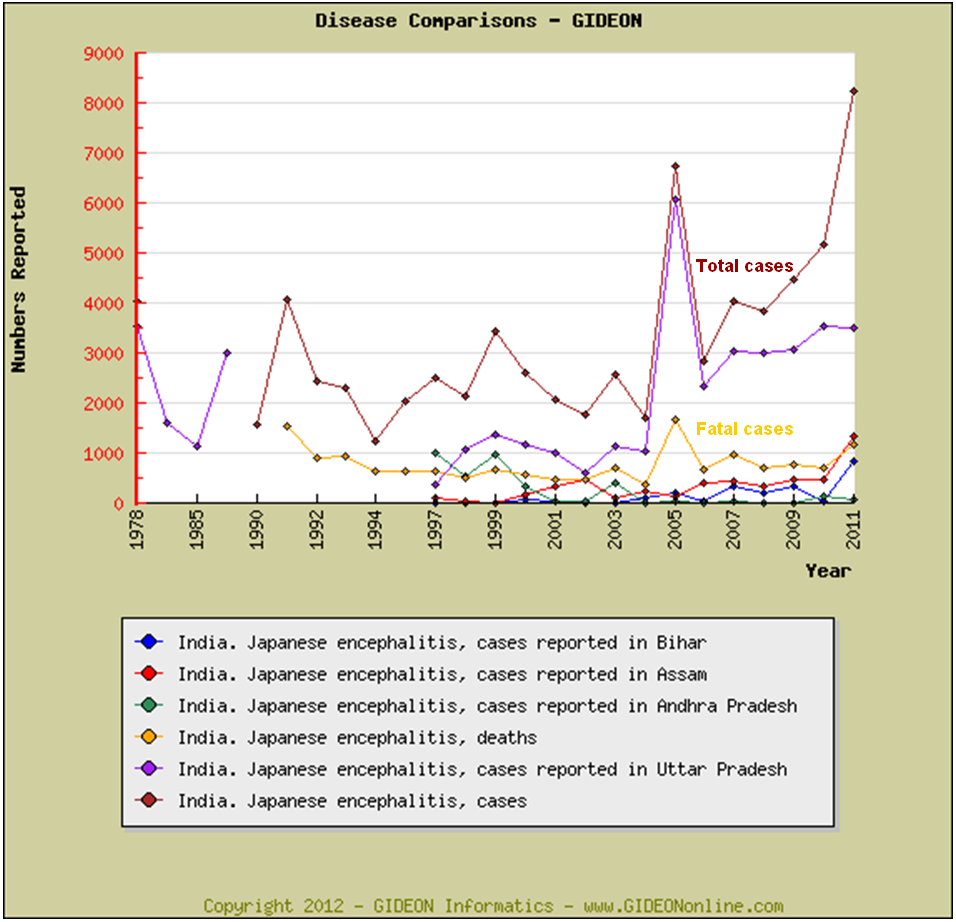
The incidence of Japanese encephalitis in India has increased dramatically since 2004, with Uttar Pradesh accounting for most cases (see graph). [1-3]

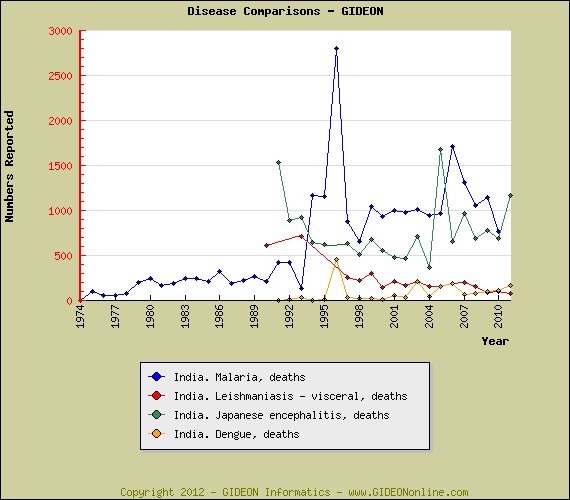
Although the reported number of fatal cases has remained fairly constant, Japanese encephalitis rivals malaria as a cause of vector-related death in this country (see graph).

References:
1. Berger SA. Infectious Diseases of India, 2012. 503 pages, 67 graphs, 4248 references. Gideon e-books, https://www.gideononline.com/ebooks/country/infectious-diseases-of-india/
2. Berger SA. Japanese Encephalitis: Global Status, 2012. 59 pages, 51 graphs, 650 references. Gideon e-books, https://www.gideononline.com/ebooks/disease/japanese-encephalitis-global-status/
3. Gideon Graph Tool, see tutorial at https://www.gideononline.com/wp-content/uploads/Gideon-Graphs.pps

Pertussis in the United Kingdom

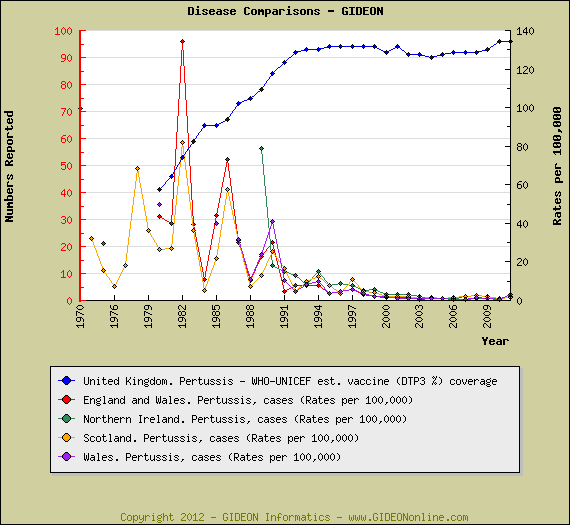
Notwithstanding increasing incidence during 2011 to 2012, the United Kingdom remains a paradigm for the success of pertussis vaccine. In the following graph, I’ve contrasted reported disease rates vs. vaccine uptake. [1-3]

References:
1. Berger SA. Infectious Diseases in the United Kingdom, 2012. 1029 pp, 797 graphs, 3290 references. Gideon e-books, https://www.gideononline.com/ebooks/country/infectious-diseases-of-the-united-kingdom/
3. Berger SA. Pertussis: Global Status, 2012. 340 pp, 506 graphs, 401 references. Gideon e-books, https://www.gideononline.com/ebooks/disease/pertussis-global-status/
4. Gideon Graph Tool at https://www.gideononline.com/wp-content/uploads/Gideon-Graphs.pps

Note featured on ProMED

Pertussis in Australia and New Zealand

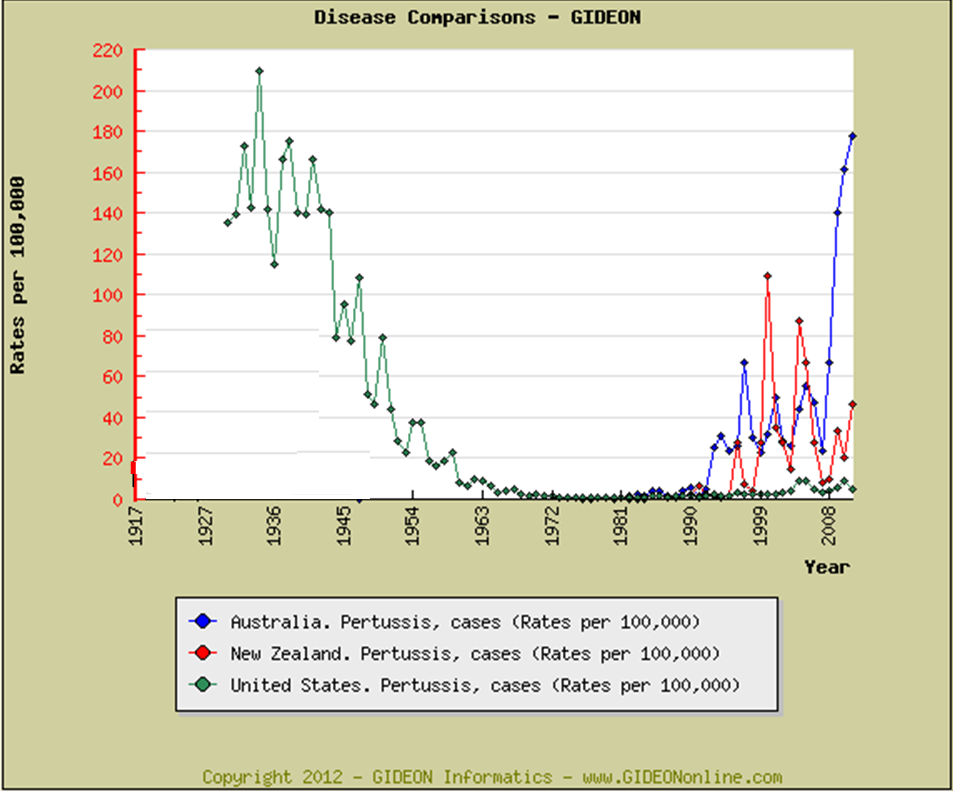
Since the 1990’s, rates of pertussis in Australia and New Zealand have increased dramatically, and are currently at levels which have not been encountered in the United States for over sixty years. [1-4] See graph:

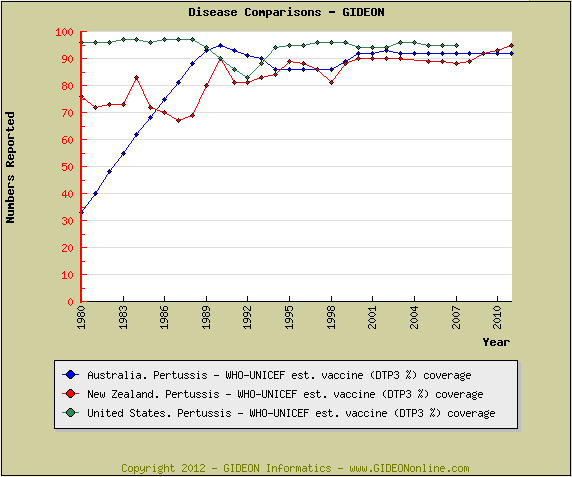
These trends do not reflect a lapse in vaccine uptake. See graph:

References:
1. Berger SA. Infectious Diseases of Australia, 2012. 519 pp, 161 graphs, 2950 references. Gideon e-books, https://www.gideononline.com/ebooks/country/infectious-diseases-of-australia/
2. Berger SA. Infectious Diseases of New Zealand, 2012. 413 pp, 136 graphs, 1534 references. https://www.gideononline.com/ebooks/country/infectious-diseases-of-new-zealand/
3. Berger SA. Pertussis: Global Status, 2012. 340 pp, 506 graphs, 401 references. https://www.gideononline.com/ebooks/disease/pertussis-global-status/
4. Gideon graph tool at https://www.gideononline.com/wp-content/uploads/Gideon-Graphs.pps

Note featured on ProMED

Human Trypanosomiasis in India

In addition to a variety of animal hosts noted by ProMED, rare cases of Trypanosoma evansi infection have been reported in humans. [1]

A farmer in Maharashtra State, India was treated for T. evansi infection in 2004. The parasite may have been acquired through a wound on his finger, and was related to a lack of serum factor which normally inhibits this species (apolipoprotein L1). 4.5% of persons in the area were found to be seropositive toward T. evansi.

In 2007, three additional cases of human T. evansi infection were reported in Maharashtra State, including a two month old infant in Mumbai. One additional case, a 37 day-old infant in Uttar Pradesh, was reported in 2010.

Natural hosts for Trypanosoma evansi infection in India include buffalo, camels, horses, pigs, cattle, dogs, jaguars and tigers. Infection of Himalayan black bears (Selenarctos thibetanus) has been reported in neighboring Pakistan.

References:
1. Berger SA. Infectious Diseases of India, 2012. 503 pp, 67 graphs, 4248 references. Gideon e-books, https://www.gideononline.com/ebooks/country/infectious-diseases-of-india/

Lyme Disease in Canada

The following background information is abstracted from Gideon www.GideonOnline.com and the Gideon e-book series. [1,2]

Time and Place:
The first case of Lyme disease in Canada was reported from Quebec in 1984.
– Approximately 100 cases had been reported as of 1990 (67 of these from Ontario); 205 as of 1994 (105 of these autochthonous).
– As of 1997, cases were reported from New Brunswick, Quebec, Ontario, southern Manitoba and British Columbia.
– 280 cases were reported from Ontario during 1981 to 1998 (127 locally acquired); 172 during 1999 to 2004 (31 locally-acquired).
– 20 cases were reported in Alberta during 1989 to 2008.
– Nova Scotia reported its first locally-acquired case of Lyme disease in 2002.
– 93 cases were confirmed in British Columbia during 1997 to 2008 (true number estimated at 142).

Vectors and Reservoirs:
– The local vectors include the deer tick (Ixodes scapularis), western blacklegged tick (I. pacificus) and rabbit tick (Haemaphysalis leporispalustris – possibly an enzootic vector in Alberta).
– As of 2000, I. scapularis had been found in over 250 locations in Canada including Ontario, Newfoundland, Nova Scotia , New Brunswick, Quebec, Manitoba, Prince Edward Island and Saskatchewan; the Long Point Peninsula on Lake Erie (southern Ontario); Point Pelee National park and Rondeau Provincial Park on the north shore of Lake Erie; and Atlantic Canada.
– I. pacificus is found in the southern and coastal regions of British Columbia (Borrelia burgdorferi has also been found in Ixodes angustus in these areas), the Gulf Islands and Vancouver Island.
– Passerine birds appear to disperse infected ticks in Canada.
– An infected tick (Ixodes scapularis) was found on a bird (common yellowthroat = Geothlypis trichas) in Nova Scotia (1999).
– Borrelia burgdorferi has been identified in an additional avian tick species, Ixodes auritulus.
– Borrelia garinii has been identified in seabird ticks (Ixodes uriae) in Newfoundland. Ixodes uriae is a known parasite of deer mice (Peromyscus maniculatus) on the Gannet Island Archipelago, Newfoundland and Labrador.

Prevalence surveys:
12.5% I. scapularis, including 10.1% of ticks collected from humans (2006 publication)
8% of I. scapularis nymphs recovered from northward migrating birds in non-endemic areas of Eastern Canada (2005 to 2006)
11.4% of ticks collected from songbirds (2004 to 2006)
67% of tick pools collected at Turkey Point Provincial Park, Ontario (2005 to 2006)
29.5% of ticks infesting songbirds, nationwide (2011 publication)

References:
1. Berger SA. Infectious Diseases of Canada, 2012. 496 pages, 107 graphs, 3130 references. Gideon e-books, https://www.gideononline.com/ebooks/country/infectious-diseases-of-canada/
2. Berger SA. Lyme Disease: Global Status, 2012. 73 pages, 65 graphs, 593 references. Gideon e-books, https://www.gideononline.com/ebooks/disease/lyme-disease-global-status/

Coccidioidomycosis in the United States

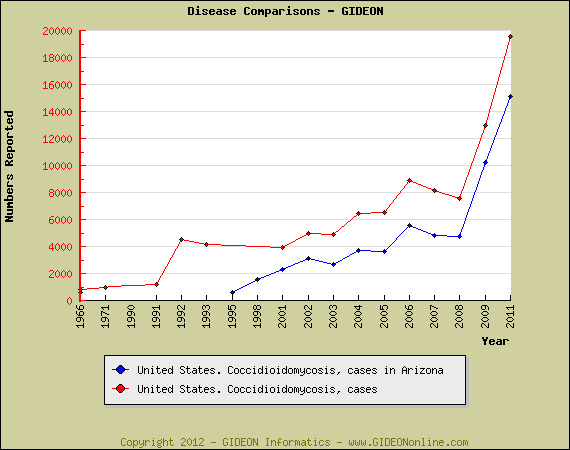
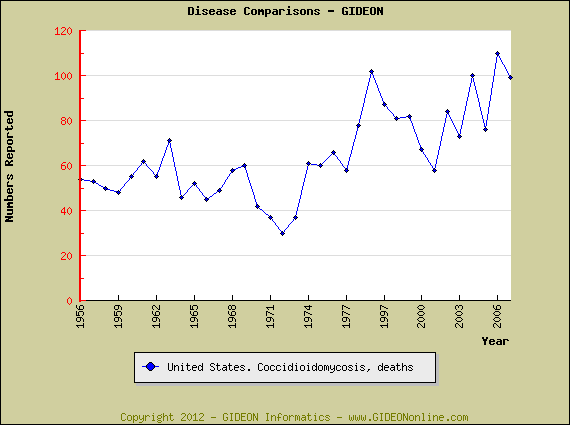
Most of the increasing incidence of coccidioidomycosis in the United States since 2000 has consisted of cases in Arizona – see graph 1. The number of fatal cases has also increased during this period – see graph 2.

Source: Gideon www.GideonOnline.com

Featured on ProMED

Rabies: Exported from India and Imported into the United Kingdom

Regarding a recent report of human rabies imported into the United Kingdom from India, the following will summarize relevant cases reported during the past 25 years: [1,2] 62 cases of travel-related rabies were reported during 1987 to 2012, of which seven were imported into the United Kingdom and 10 followed animal contact in India. [3]

Cases imported into the United Kingdom:
Year / Origin
1987 / India
1996 / Nigeria
2001 / Philippines
2001 / Nigeria
2005 / India
2008 / South Africa
2012 / India

Cases exported from India:
Year / Country
1987 / United Kingdom
1997 / France *
2004 / Germany
2004 / Germany
2005 / United Kingdom
2007 / Lithuania
2009 / United Arab Emirates
2009 / United States
2012 / Italy
2012 / United Kingdom

* Infection was acquired in either India or Nepal

References:
1. Berger SA. Infectious Diseases of India, 2012. 503 pp, 67 graphs, 4248 references. Gideon e-books, https://www.gideononline.com/ebooks/country/infectious-diseases-of-india/
2. Berger SA. Infectious Diseases of the United Kingdom, 2012. 1029 pp, 797 graphs, 3290 references. Gideon e-books, https://www.gideononline.com/ebooks/country/infectious-diseases-of-the-united-kingdom/
3. Berger SA. Rabies: Global Status, 2012. 376 pp, 546 graphs, 1375 references. Gideon e-books, https://www.gideononline.com/ebooks/disease/rabies-global-status/

Note featured on ProMED
GIDEON Sign In