GIDEON blog

Free Demo ► Latest Updates ► Video Tutorials ►
Subscribe , j x

Anthrax in the Yugoslav Republics

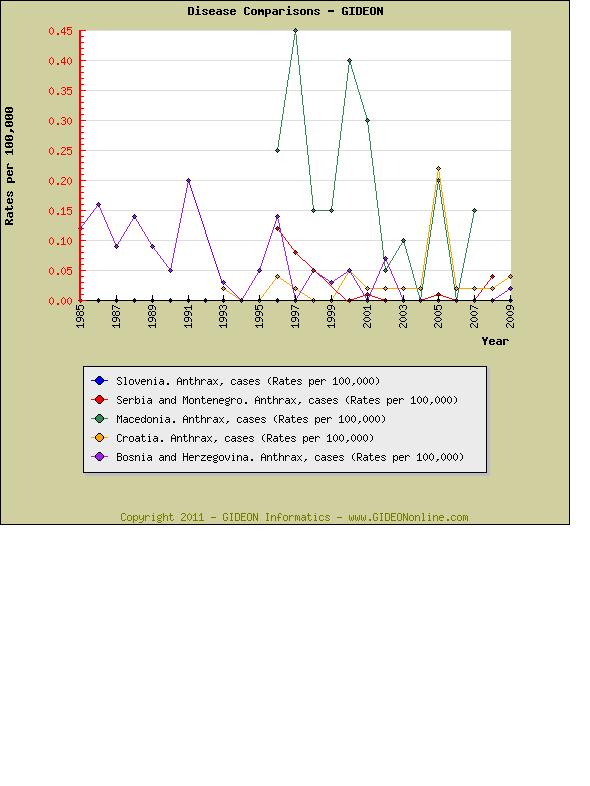
Recent reports from Serbia remind us that Anthrax continues to occur in the republics of former Yugoslavia. Highest rates of human disease are reported in Macedonia (see graph). 1,2

References:
1. Berger SA. Infectious Diseases of Serbia and Montenegro, 2011. 437 pp, 212 graphs, 1035 references. Gideon e-books, https://www.gideononline.com/ebooks/country/infectious-diseases-of-serbia-and-montenegro/
2. Berger SA. Anthrax: Global Status, 2011. 287 pp, 452 graphs, 1265 references. Gideon e-books, https://www.gideononline.com/ebooks/disease/anthrax-global-status/

Diphtheria in Paraguay

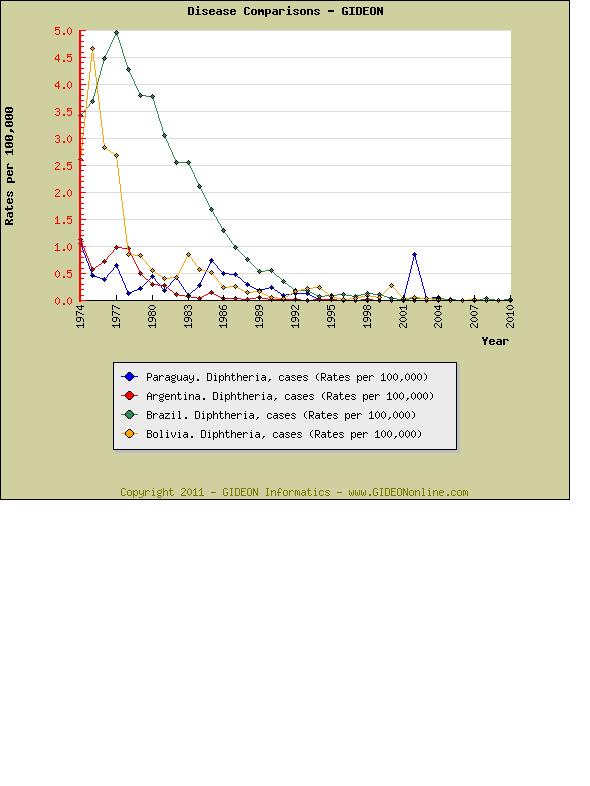
Notwithstanding an outbreak in 2002, diptheria in Paraguay and neighboring countries has been largely controlled since the 1980’s. 1,2 (see graph)
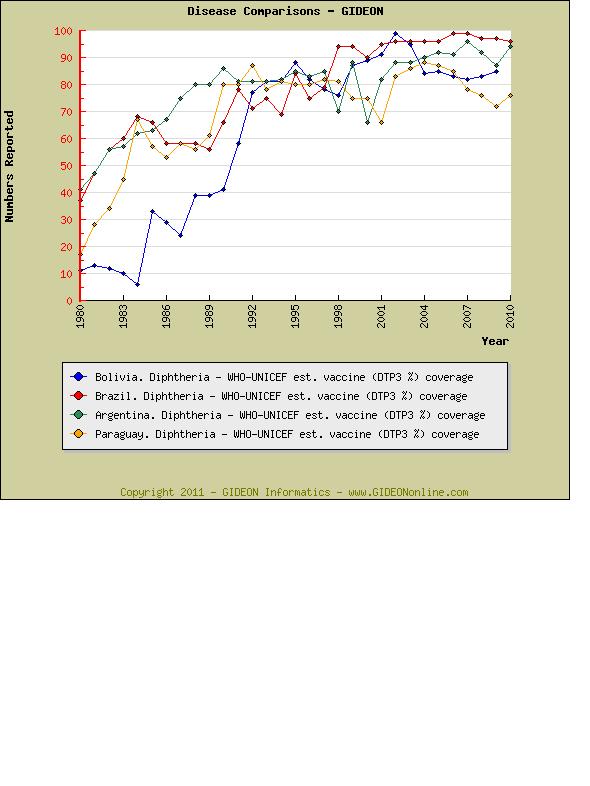
Allthough decreasing rates have paralleled efficient implementation of DPT vaccination in the area, immunization rates in Paraguay have been relatively low. (see graph)

References:
1. Berger SA. Infectious Diseases of Paraguay, 2011. 345 pp, 82 graphs, 906 references. Gideon e-book series, https://www.gideononline.com/ebooks/country/infectious-diseases-of-paraguay/
2. Berger SA. Diptheria: Global Status, 2011. 303 pp, 441 graphs, 259 references https://www.gideononline.com/ebooks/disease/diphtheria-global-status/

Update: Posted in ProMED

Schistosomiasis in the Philippines

The following background data on schistosomiasis in the Philippines are abstracted from the Gideon e-book series. [1,2] (Primary references available on request).

Time and Place:
Schistosomiasis was first reported in the Philippines in 1906.
During the 1970’s schistosomiasis was endemic to:
– Mindoro Oriental and Sorsogon in Southern Luzon
– The provinces of North, East and Western Samar
– Leyte
– Bohol in Eastern Visayas
– All the provinces of Mindanao with the exception of Misamis Oriental, Davao Oriental and Maguindanao.
The disease is currently most common in Bohol, Lake Naujan, coastal Mindanao, Samar and southeastern Luzon.

In 1921, an estimated 25,000 to 30,000 people were infested – this number had increased to 300,000 by 1948.
– Ten million live in endemic areas, as of 2002, an estimated 800,000 were infested and 6.7 million were at risk.
– As of 2010, an estimated 560,000 persons were infested.
– 12,273 cases of schistosomiasis were officially reported in 1988; 4,240 in 2000; 6,628 in 2004; 9,383 in 2005; 3,517 in 2006
– 301 deaths were ascribed to schistosomiasis in 1988.

Reservoirs:
– Infection is common among dogs.
– Infection is common among field water buffaloes and rats on Leyte.
– The local snail reservoir is Oncomelania hupensis quadrasi

Prevalence surveys:
36.0% in rice farming villages on Leyte (2005 publication)
20% in Mindanao, Leyte, Samar and Mindoro (1941)
16% in Malay-balay, Mindanao (1981 publication)
20% in Oriental Mindoro (1978)
15% in North Samar (1977 publication)
49.5% in Bolos and Gamapin barangays (rural Luzon, 1978)
80% of children in eastern Leyte (1945)
17.4% of humans, 0.5% of cats, 7% of dogs, 0.1% of pigs, 37.6% of rats and 0.1% of water buffalo in Western Samar (2003 to 2004)
1.6% to 86.3% of dogs, 0.1% to 21.7% of cats, 0.01% to 18.4% of pigs, 0.1% to 72.5% of water buffaloes, and 0.7% to 95.4% of rats in Samar Province (2007 publication)
0% to 45.2% of rural villagers in Samar Province (2003 to 2004)
5% in Trinidad and Talibon townships, Bohol Province (1980 publication)
10% in Surigao del Norte (2005)
10% to 15% of pigs and water buffalo in endemic areas.
1.6% to 86.3% of dogs in 50 endemic villages, 0.1% of 21.7%, 0.01% to 18.4% of pigs, <0.1% to 72.5% of water buffaloes, and 0.7% to 95.4% of rats. (Samar Province, 2007 publication) 51.5% of buffaloes in Macanip, Leyte (PCR, 2008) Notable outbreaks: 1944 to 1945 - An outbreak (1,700 cases) was reported among United States and Australian Army personnel (174 cases) serving in the Philippines. 2000 - An "outbreak" was reported in Davao del Sur, with 222 cases as of October - most in the barangays of Digos- Igpit, Colorado, and Matti. References: 1. Berger SA. Infectious Diseases of the Philippines, 2011. 379 pages, 72 graphs, 1264 references. Gideon e-books. https://www.gideononline.com/ebooks/country/infectious-diseases-of-the-philippines/
2. Berger SA. Schistosoma Japonicum: Global Status, 2011. 14 pages, Gideon e-books. https://www.gideononline.com/ebooks/disease/schistosoma-japonicum-global-status/

Update: Posted in ProMED

Lyme Disease in Pennsylvania

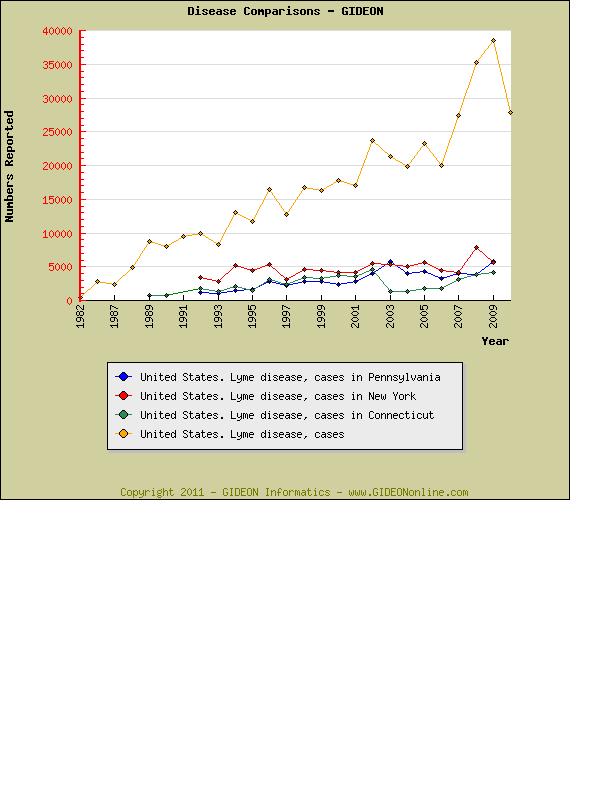
Although the incidence of Lyme disease the United States has been steadily increasing since 1993, case numbers for Pennsylvania, New York and Connecticut (the three states with highest disease rates) have not changed substatially. [1,2] See graph

References:
1. Berger SA. Infectious Diseases of the United States, 2011. 1030 pp, 464 graphs, 8237 references. Gideon E-books, https://www.gideononline.com/ebooks/country/infectious-diseases-of-the-united-states/
2. Berger SA. Lyme Disease: Global Status, 2011. 68 pages, 61 graphs, 496 references. Gideon E-books, https://www.gideononline.com/ebooks/disease/lyme-disease-global-status/

Update: Posted in ProMED

E. coli: Travel-related, Cross-border and Extensive Outbreaks

The following chronology of Travel-related and Cross-border outbreaks of E. coli gastroenteritis is abstracted from the Gideon e-book series. [1,2] (Primary references are available on request)

Travel-related outbreaks:
1976 – An outbreak (386 cases) of diarrhea due to Salmonella, Vibrio, Shigella, ETEC and EIEC was reported among passengers of a cruise ship following a visit to Haiti.
1981 – An outbreak (98 cases) of diarrhea due to Salmonella, Vibrio and ETEC was reported among passengers of a cruise ship following a visit to Mexico.
1997 – An outbreak was reported among tourists from Finland, Denmark, Sweden and the United Kingdom, who acquired E. coli O157 infection (3 with HUS) at a resort hotel in the Canary Islands. No cases were registered in the local population.
1999 – An outbreak (5 cases, 2 HUS) of E. coli O157 infection was reported among British tourists in southern Turkey.
2002 – An outbreak (2 confirmed, 8 suspected cases) of E. coli O157 infection among school staff and pupils from England occurred during a visit to France. The probable source was salad prepared from Belgian cucumbers.
2004 – An outbreak (107 cases) of E. coli O111 infection was reported among Japanese students on tour in Korea.
2004 – An outbreak (9 verified and 3 secondary cases) of E. coli O157 infection was associated with an international sporting event.
2004 – An outbreak (3 cases) of E. coli O157:H7 infection on Okinawa, Japan was ascribed to contaminated ground beef supplied to military personnel from the United States.
2005 (publication year) – An outbreak (24 cases) of EAggEC infection was reported among Cambodian tourists in Japan.
2005 – An outbreak (10 confirmed, 5 suspected cases) was reported among Scottish tourists returning from resorts in Turkey.
2006 to 2007 – 41.9% of American travelers to Mexico developed diarrhea – 33.9% due to LT-EHEC
2007 – An outbreak (3 cases, 2 confirmed) of E. coli O157 infection was reported among Scottish tourists returning from Turkey.
2009 – An outbreak (14 cases) of E. coli O157 infection was reported among British travelers to Spain.

Cross-border outbreaks:
1983 – Outbreaks of gastrointestinal illness associated with eating imported French Brie cheese occurred in the United States. The responsible organism in this case was a strain of Escherichia coli serotype O27:H20 which produced a heat-stable toxin.
1996 – Outbreaks (3 outbreaks, one fatal case) in the United States and Canada were caused by unpasteurized apple juice.
2006 – An outbreak (205 cases, 30 HUS, 3 fatal) of E. coli O157:H7 infection from contaminated California fresh spinach involved 26 states. An additional suspect case was reported in Ontario. The outbreak strain was identified in feral swine in the area of spinach production.
2006 – An outbreak (21 cases) of sorbitol fermenting E. coli O157 infection was reported in England and Scotland.
2007 – An outbreak (45 cases, 1 HUS, 0 fatal) of E. coli O157:H7 infection involving 8 states (40 cases) and Canada was caused by contaminated beef patties.
2007 – Outbreaks (50 cases, 0 HUS) of E. coli O157 in the Netherlands (41 cases) and Iceland (9 cases) may have been related to contaminated iceberg lettuce.
2008 – An outbreak (23 cases) of E. coli O157:H7 infection was reported among university students in the United States was ascribed to contaminated iceberg lettuce. Ten additional cases outside of the University were epidemiologically-linked to the outbreak, including 2 suspected cases in southern Ontario.
2010 – Outbreaks (260 cases in 11 outbreaks) of Norovirus and EHEC infections in Denmark were caused by contaminated lettuce imported from France.

Extensive (100 cases or more) outbreaks:
1969 (publication year) – An outbreak (418 cases hospitalized) of E. coli O86:B7 gastroenteritis was reported in India.
1974 – An outbreak (106 cases) of infantile diarrhea caused by enteropathogenic E. coli 0111:B4 was reported in Turkey.
1975 – An outbreak (2,200 cases or more) of E. coli O6:K15:H16 infection at an American National Park was attributed to contaminated drinking water.
1981 – An outbreak (282 cases) of E. coli gastroenteritis was reported among personnel at a hospital in the United States.
1987 – An outbreak (650 cases) of E. coli O111:B4 infection was reported at a school complex in southern Finland.
1988 – An outbreak (670 cases) of E. coli O164:H- infection was associated with consumption of “Godofu (Sasayuki tofu).”
1988 – An outbreak (256 cases) of gastroenteritis in Japan was ascribed to Escherichia coli O167:H9; a second outbreak (174 cases, 14 HUS) of hemorrhagic colitis associated with Escherichia coli O157:H7 was reported in a Japanese kindergarten.
1989 – An outbreak (243 cases) of E. coli O157:H7 infection in the United States resulted in 2 cases of HUS and 4 deaths.
1991 – An outbreak (521 cases, estimated) of verotoxin-producing E. coli infection was reported in the Canada.
1992 – An outbreak (64,699 clinical cases) of E. coli O157 infection was reported in Swaziland. The source of the outbreak was drinking water contaminated by infected cattle. This was the first known outbreak in Africa.
1992 to 1993 – An outbreak (732 cases, 151 hospitalized, 4 fatal) of hemorrhagic colitis due to Escherichia coli O157:H7 in the United States was traced to contaminated hamburger meat.
1993 – An outbreak (2,697 cases) of enteroaggregative E. coli infection in Japan was caused by contaminated school lunches.
1993 – An outbreak (121 cases) of ETEC infection in the United States was associated with salads served at a lodge buffet.
1995 to 1996 – An outbreak (100 cases, 29 HUS, 0 fatal) of E. coli O157 infection was reported in Sweden.
1996 – An outbreak (108 cases, 4 fatal) of E. coli O157 diarrhea was reported in Central African Republic. This was the first description of E. coli O157 in central Africa.
1996 – Outbreaks (17,877 cases, 12 fatal) of VTEC O157 were reported in Japan.
1996 – An outbreak (512 confirmed cases, 151 hospitalized; 34 HUS or TTP; 22 fatal) in Scotland was traced to meat from a local butcher; a second Scottish outbreak (711 cases) of Campylobacter and E. coli O157 infections was caused by contaminated water.
1997 to 1998 – An outbreak (298 cases) of bloody diarrhea due to E. coli O157, Shigella and amebiasis was reported in the Cameroon.
1998 – An outbreak (144 cases) of ETEC infection was reported in Iceland.
1998 – An outbreak (4,000 cases or more) of enterotoxic E. coli infection in the United States was associated with potato salad; and a second American outbreak (142 cases) was ascribed to coleslaw served at a restaurant.
1998 – An outbreak (175 military personnel and 54 civilians) of ETEC infection in Israel was associated with contaminated water.
1998 – An outbreak (157 cases, 4 HUS) of E. coli O157:H7 infection in the United States occurred when waste (from deer and elk) contaminated a municipal water supply. {p 11971769}
1999 – An outbreak (149 cases, total) of mixed E. coli O157 (126 cases, 11 HUS, 2 fatal) and Campylobacter (43 cases) infection in the United States was caused by contaminated well water at a fairgrounds.
1999 – An outbreak (114 confirmed cases) of E. coli O157 infection (28 hospitalized; 3 HUS) in England was caused by contaminated milk from a local dairy.
1999 – An outbreak (329 cases, 22 hospitalized) of E. coli O157:H7 infection in the United States was traced to contaminated beef eaten during a party at a cow pasture; an unrelated American outbreak (281 cases) of E. coli O157:H7 infection was associated with a pig, steer and ostrich roast.
1999 – An outbreak (125 suspect cases) of E. coli O157:H7 infection was reported in Canada. A petting zoo was implicated as the source for infection; a second outbreak (143 cases) of E. coli O157:H7 infection in Canada was caused by contaminated salami.
1999 – An outbreak (177 fatal cases) of E. coli O157:H7 infection was reported in China.
1999 (publication year) – An outbreak (132 cases) of E. coli 0169 infection was reported in Japan; and a second outbreak of (126 cases) of Shiga toxin-producing Escherichia coli O118:H2 infection at a junior high school was associated with consumption of salads.
2000 – An outbreak (1,346 cases, 65 hospitalized, 27 HUS, 6 fatal) of E. coli O157 and Campylobacter infections in Canada was ascribed to contaminated drinking water.
2000 – An outbreak (181 cases) of E. coli O157:H7 infection (including 6 HUS, none fatal) was reported among school children and their contacts in Spain. Sausages were identified as the source.
2000 – An outbreak (1,304 cases – 58 confirmed) of E. coli O157:H7 infection due to barbecued beef was reported following an outdoor event in Japan; a second outbreak (842 cases – 87 confirmed) of E. coli O157:H7 infection was reported in a hospital and home for the aged; and a third outbreak (743 cases – 15 confirmed) of E. coli O157:H7 infection in a Japanese hospital.
2000 – An outbreak (1,521 cases) of presumed ETEC infection in Mexico was caused by sewage overflow.
2001 – An outbreak (264 cases) of E. coli O157 infection from contaminated meat was reported in Japan; and a second food-borne outbreak (195 cases) of E. coli O157:H7 infection was reported in the country.
2002 (publication year) – An outbreak (162 cases) of Escherichia coli 0157:H7 in Canada was related to exposure to goats and sheep at a fair.
2002 – An outbreak (113 cases, 4 fatal) of E. coli O157 infection was reported in a hospital and a nursery home in Japan; a second Japanese outbreak (123 cases) of E. coli O157:H7 infection involved a hospital and home for the aged; and a third outbreak (328 cases) caused by heat stable ETEC-producing E. coli O25 was related to contaminated box lunches.
2003 – An outbreak (141 cases) of E. coli O26:H11 infection in Japan was ascribed to contaminated food.
2003 – An outbreak (463 cases, 56 fatal, 32 confirmed) of E. coli O157 infection was reported among children in Kenya.
2004 – An outbreak (111 cases) of ETEC infection caused by three serotypes of E. coli was reported among employees of a company in the United States; and a second American outbreak (130 cases) of ETEC infection was associated with a sushi restaurant.
2005 – An outbreak (401 cases) of E. coli O6:H16 food poisoning involved two prisons in Japan.
2005 – An outbreak (135 cases, 11 HUS) of E. coli O157 infection in Sweden was related to contaminated lettuce.
2005 – An outbreak (160 cases, 1 fatal) of E. coli O157 infection affecting over 40 schools in Wales was ascribed to contaminated meat.
2006 – An outbreak (205 cases, 30 HUS, 3 fatal) of E. coli O157:H7 infection from contaminated fresh spinach was reported in the United States.
2006 – An outbreak (217 cases) of Salmonella anatum and ETEC infections among guests at a high school dinner in Denmark was caused by contaminated pesto.
2007 – An outbreak (467 cases) of E. coli O157:H7 infection was reported at a school refrectory in Japan; and a second outbreak (314 cases) of E. coli O157:H7 infection was reported in a Japanese restaurant.
2007 – An outbreak (117 cases) of gastroenteritis at a camp site in Romania was caused by Salmonella enteritidis and EPEC.
2007 to 2008 – An outbreak (1,000 cases) in Finland of gastroenteritis related to contaminated drinking water included cases of STEC infection.
2008 – An outbreak (341 cases, 26 HUS, 1 fatal) of E. coli O111 infection was associated with a restaurant in the United States.
2009 – An outbreak (235 cases) of E. coli O157 infections in Canada was associated with onions served in a restaurant.

References:
1. Berger SA. Escherichia coli Diarrhea: Global Status, 2011. 139 pages, 148 graphs, 1,316 references. Gideon E-books, https://www.gideononline.com/ebooks/disease/escherichia-coli-diarrhea-global-status/
2. Berger SA. Infectious Diseases of the World, 2011. 987 pages, 383 graphs, 12,492 references. Gideon E-books, https://www.gideononline.com/ebooks/country/infectious-diseases-of-the-world/
Plague in Lybia

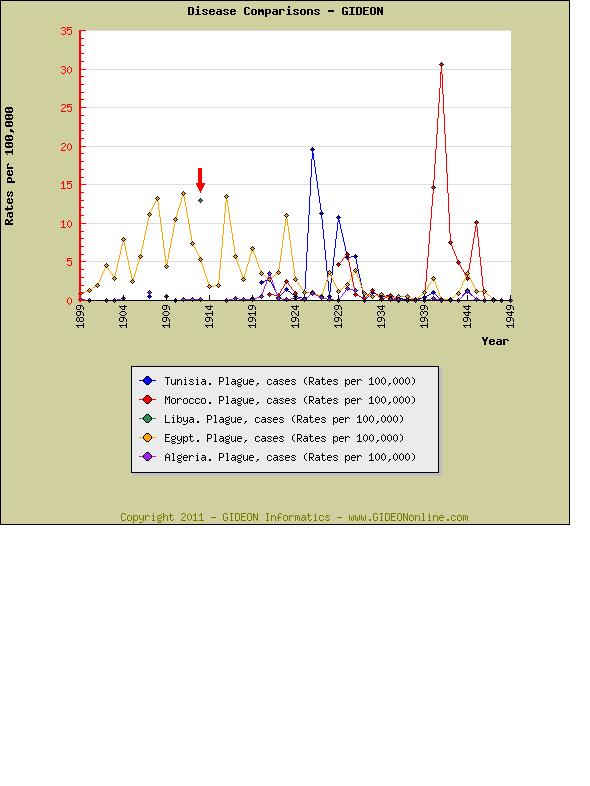
A recent outbreak in Tobruk belies the fact that only sporadic cases and small outbreaks of plague have occurred in North Africa since 1950. Successive waves of plague were reported in Egypt, Tunisia and Morocco during the first half of the 20th century (See Graph). [1,2]

Plague was relatively rare in Libya, with the exception of an outbreak of 82 cases in 1913 (red arrow).

References:
1. Berger SA. Infectious Diseases of Libya, 2011. 321 pp, 39 graphs, 930 refs. Gideon e-books, https://www.gideononline.com/ebooks/country/infectious-diseases-of-libya/
2. Berger SA. Plague: Global Status, 2011. 95 pp, 101 graphs, 485 refs. Gideon e-books, https://www.gideononline.com/ebooks/disease/plague-global-status/

Japanese Encephalitis – Germany ex. Indonesia

The following background data on Japanese encephalitis in Indonesia are abstracted from the Gideon e-book series. [1,2] (Primary references available on request)

Indonesia was the source for eight of 47 travel-associated cases reported during 1973 to 2011. Travelers from Germany were involved in four episodes during this period. [3.]

Reports of infection following exposure periods of only 10 to 14 days are disturbing, since pre-travel vaccination is often not employed for short-term trips.

Time and Place:
Japanese encephalitis was first reported in Indonesia in 1960, and the virus was first recovered from mosquitoes in this country in 1974.
– 116,114,000 persons (52% of the population) live in areas of risk.
– The area of risk consists of Bali, Irian Barat, Java, Kalimantan, Lombok, Moluccas, Nusa Tengara, Sulawesi and Irian Jaya.
– Highest activity is anticipated in the South during the rainy and early dry season; in the North during the late summer and autumn.
– The first case in Irian Jaya was confirmed in 1995 (Timika region).
– Serological confirmation of infection on Bali (12 cases) was first published in 1999.

90 cases (9 fatal) were reported among children in Bali during 2001 to 2003 (8.2 per 100,000 below age 10 years) ; 94 cases during 2001 to 2004.
– 82 cases were reported among children below age 15 during 2005 to 2006 (15 hospitals)

Prevalence surveys:
5.48% of acute encephalitis cases among children below age 15 years (2005 to 2006)

Seroprevalence surveys:
2.2% and 1.8% of individuals in Jakarta and Surabaya (Java Island, 1999 to 2001)
25% (Borneo – Moslem population; ie, no pig contact) to 52% (Bali)
87% in Iryan Jaya (1972)
52% of horses in Java (1995 publication)
49% of pigs in Bali and 6% in Java (2008)
Seropositivity has also been reported among pigs in Timor and Irian Java
23% (West Java) to 86% (North Sumatra) of cattle; 2% (West Kalimantan) to 50% (South Sulawesi) of pigs; 12% of dogs; 14% of horses; 14% (South Sulawesi) to 59% (West Kalimantan) of goats; 36% (South Sulawesi) to 44% (West Kalimantan) of fowl.

Exported cases:
1989 (publication year) – An Australian tourist acquired nonfatal infection in Bali.
1994 – Fatal infection was reported in a Danish tourist who had been on Bali for only 12 days; and nonfatal infection in a Swedish tourist who had been on Bali for only 10 days.
1995 (publication year) – An Australian child acquired nonfatal infection in Bali.
1997 – A Dutch tourist acquired Japanese encephalitis in Indonesia.
2000 – A Swedish tourist acquired Japanese encephalitis during a visit to Java and Bali.
2004 – A Dutch woman developed Japanese encephalitis (nonfatal) while traveling in Indonesia.
2011 – A Germany tourist acquired Japanese encephalitis following a two-week stay in Bali.

Vectors:
– The local vectors are Culex tritaeniorhyncus and Cx. gelidus.
– The virus has also been recovered from Anopheles vagus and An. annularis in Lombok.

References:
1. Berger SA. Infectious Diseases of Indonesia, 2011. 403 pp, 66 graphs, 1596 references. Gideon e-books, https://www.gideononline.com/ebooks/country/infectious-diseases-of-indonesia/
2. Berger SA. Japanese Encephalitis: Global Status, 2011. 55 pp, 47 graphs, 546 references. Gideon e-books, https://www.gideononline.com/ebooks/disease/japanese-encephalitis-global-status/
3. Berger SA. Infectious Diseases of Germany, 2011. 488 pp, 145 graphs, 1906 references. Gideon e-books, https://www.gideononline.com/ebooks/country/infectious-diseases-of-germany/

Tularemia in Germany

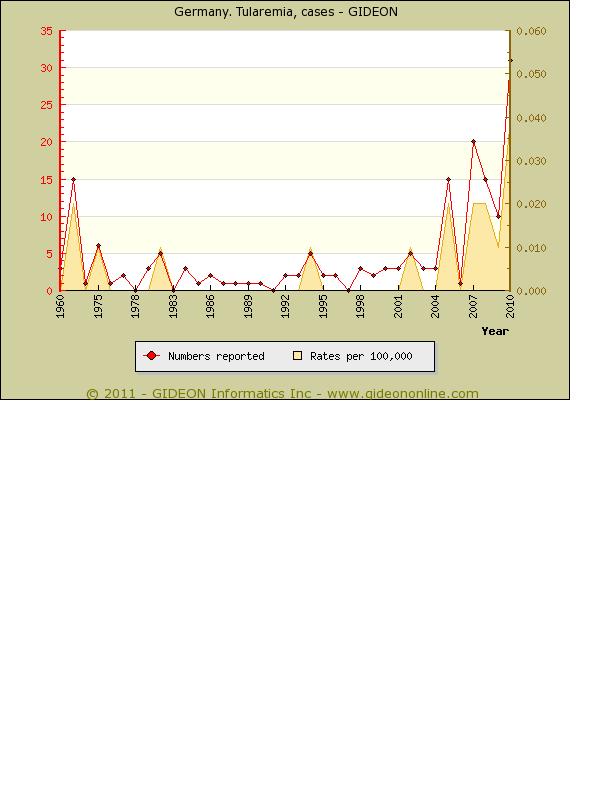
688 cases of tularemia were reported in Germany during 1949 to 2006 (including 220 cases in East Germany during 1949 to 1989) – see graph.

The following background data are abstracted from the Gideon e-book series (primary references available on request). [1,2]

Although tularemia in Germany is associated with wild animal contact, individual cases have been ascribed to ingestion of hare meat in a Berlin restaurant, and acquisition from a mosquito bite.

Prevalence surveys:
1.2% of bird-feeding and 1.5% of rodent-feeding ticks in central Germany (2007)

Seroprevalence surveys:
2.32% of persons in Leutkirch, Baden-Wuerttemberg (2008 publication)
3% of hunters in Styria and Burgenland (2003 publication)
1.7% of hunters in an endemic area (2008 publication)
3.1% of wild boars from Mecklenburg-Western Pomerania (1995 to 1996)

Isolation of Francisella tularensis subsp. holarctica from a European brown hare (Lepus europaeus) from Thuringia, Germany, was described for the first time in 2007
– F. tularensis was recovered from five species of rodents and water samples in an endemic area, with carriage rates ranging from 2.04% to 10.87% (2008 publication)

Notable outbreaks:
2005 – An outbreak (10 cases) among hunters in Griesheim (Hessen) was associated with skinning hares.
2007 (publication year) – An outbreak of tularemia was reported in a colony of semi-free-living common marmosets (Callithrix jacchus) in Goettingen.
2007 (publication year) – An outbreak of tularemia (18 cases) was reported among captive cynomolgus monkeys (Macaca fascicularis) at a Primate Center.
2007 – An outbreak (3 cases) in Baden Wertemberg was associated with rabbit contact.

References:
1. Berger SA. Infectious Diseases of Germany, 2011. 488 pp, 145 graphs, 1906 references. Gideon e-book series, https://www.gideononline.com/ebooks/country/infectious-diseases-of-germany/
2. Berger SA. Tularemia: Global Status, 2011. 45 pp, 39 graphs, 336 references. Gideon e-book series, https://www.gideononline.com/ebooks/disease/tularemia-global-status/

Rabies in Mexico

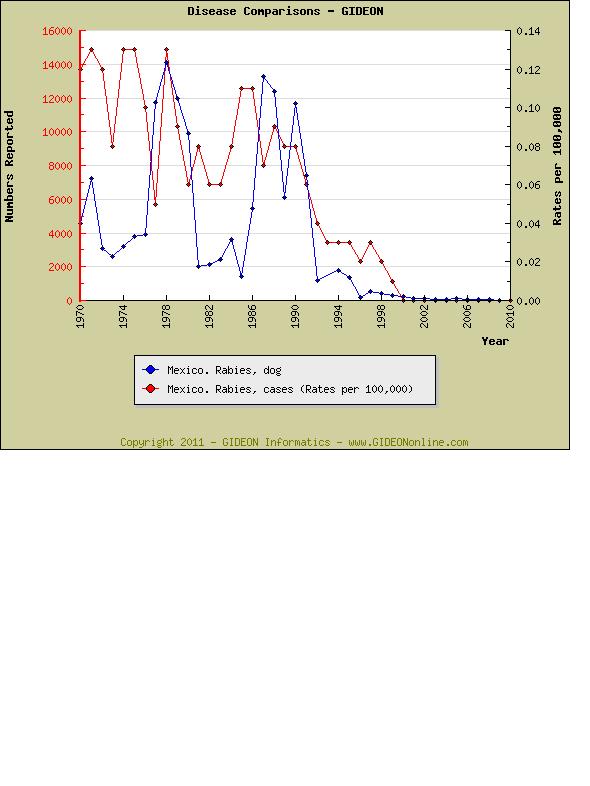
Mexico offers a useful paradigm for the impact of canine rabies control on human disease. The attached graph contrasts reports of dog rabies vs. rates per 100,000 humans in this country. [1,2]

References:
1. Berger SA. Infectious Diseases of Mexico, 2011. 446 pp, 128 graphs, 1655 references. Gideon e-books, https://www.gideononline.com/ebooks/country/infectious-diseases-of-mexico/
2. Berger SA. Rabies: Global Status, 2011. 366 pages, 546 graphs, 1056 references. Gideon e-books, https://www.gideononline.com/ebooks/disease/rabies-global-status/

Avian Influenza H5N1 – Graphic Summary

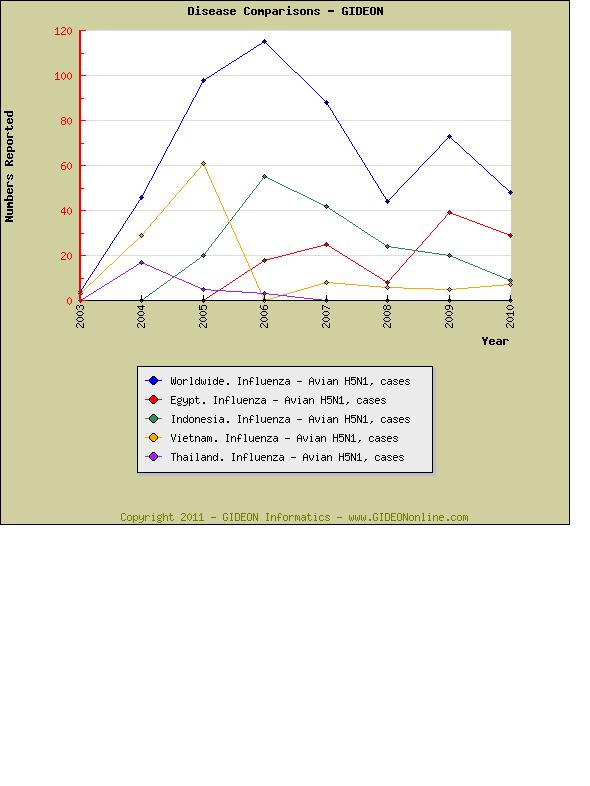
The attached graph summarizes successive waves in the occurrence of Influenza H5N1 among individual countries. Incidence peaked in Thailand in 2004, Vietnam in 2005 and Indonesia in 2006; while most reports during 2009 to 2010 originated from Egypt. [1]

References:
1. Berger SA. Infectious Diseases of the World, 2011. 987 pp, 383 graphs, 12,492 references. Gideon e-books, https://www.gideononline.com/ebooks/country/infectious-diseases-of-the-world/
GIDEON Sign In