An impending outbreak in Khujand belies the fact that reported rates of Hepatitis A in Tajikistan and neighboring countries have actually decreased in recent years. See graph 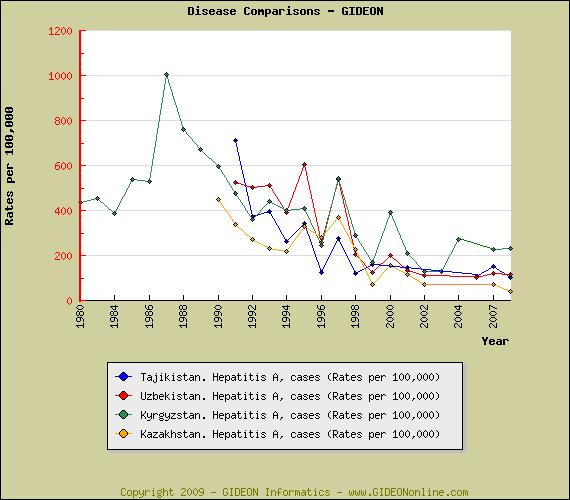
December 7th 2009
Hepatitis A in Tajikistan
November 28th 2009
Malaria in Georgia
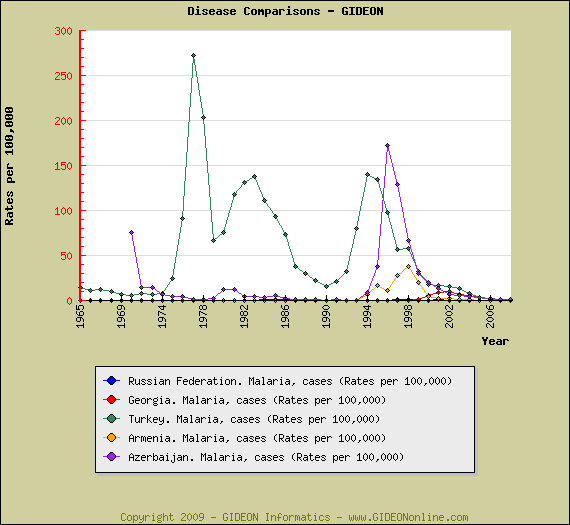
Although autochthonous cases continue to be reported, malaria rates in Georgia and surrounding countries have decreased considerably since 1999. With the exception of Russia, all of the countries which border Georgia had reported higher rates in recent years.
November 7th 2009
Malaria in Italy
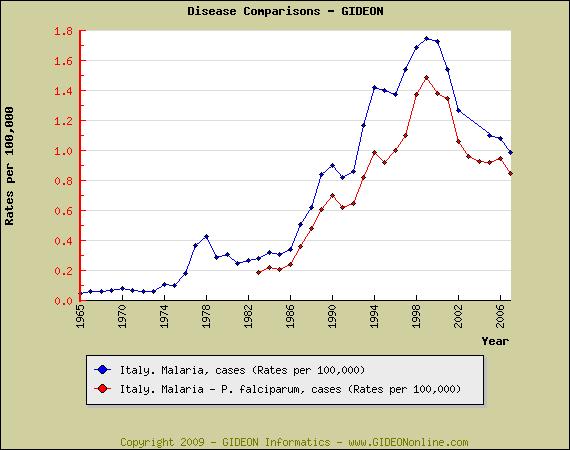
A recent case in the Lake Fondi region reminds us that the potential for malaria transmission persists in Europe. In fact, sporadic reports of cryptic, airport- and locally-acquired malaria have appeared in the Italian literature in recent years. The following review of malaria in Italy was abstracted from GIDEON.
Historical background
- Malaria was eradicated from Sardinia during 1946 to 1950, through massive application (267 metric tons) of DDT.
- A single endemic case (Plasmodium vivax in Palma di Montechiaro, Sicily) was reported in 1956; with sporadic cases in the area of Palermo during 1962.
- The country was declared ‘malaria-free’ in 1970.
- A single case of autochthonous malaria (P. vivax) was reported in Maremma (Tuscany) in 1997 – Anopheles labranchiae was implicated as the vector.
Although disease rates have increased in recent years, imported malaria continues to be less common than in neighboring France and Switzerland.
October 25th 2009
Major Outbreaks of Leptospirosis
In view of a massive ongoing outbreak in Manila, the following chronology of published large outbreaks (>50 cases) of leptospirosis was abstracted from GIDEON. Outbreaks known to be associated with heavy rains or flooding are denoted by * A number of additional outbreaks have been associated with floods, but without specific mention of case numbers. Thus, a major outbreak in Krasnodar (Russia) in 1997 followed local flooding; as did epidemics in China during 1962 to 1963, 1966, 1973 to 1974 and 1984.
The Epidemiology module in GIDEON currently contains details of 8,910 Infectious Diseases outbreaks (Primary references are available on request)
| Year | Cases (fatal) | Location | Details |
|---|---|---|---|
| 1931 | 126 | Portugal | ascribed to entry of rat urine into drinking fountain |
| 1933 to 1934 | 86 | Chile | the first identification of leptospirosis in Chile |
| 1942 to 1944 | 120 | United States | serovar. Automnalis , in Fort Bragg, North Carolina (thus “Fort Bragg Fever”). |
| 1950 | 50 | United States | associated with pig contamination of a creek |
| 1953 | 114 | Japan | followed swimming in river contaminated by dogs |
| 1964 | 61 | United States | cattle contamination suspected |
| 1980 | 104 | Albania | |
| 1987 | 93 | Republic of Korea * | |
| 1989 | 144 (6) | New Caledonia | |
| 1992 | 79 | Cuba | affected primarily sugar cane cutters |
| 1995 | 2,419 (48) | Nicaragua * | |
| 1996 | 1,425 (22) | Brazil | |
| 1996 | 326 (50) | Brazil | |
| 1997 | 562 (68) | India | |
| 1998 | 68 | Honduras * | |
| 1998 | 2,000 (7) | Kazakhstan | |
| 1999 | 143 (28) | India * | |
| 1999 | 200 (19) | New Caledonia | |
| 1999 | 72 | Peru | outbreak among military recruits |
| 2000 | 157 (13) | Brazil | |
| 2000 | 80 (0) | Malaysia | associated with an international sporting event |
| 2000 | 143 | India * | |
| 2001 | 129 (0) | New Caledonia | |
| 2002 | 143 (11) | India | |
| 2003 | 80 | Ecuador * | |
| 2003 | 204 (27) | India | |
| 2004 | 550 (75) | India | |
| 2004 | 141 (12) | Kenya | outbreak among high school students |
| 2004 | 80 | Russian Federation | followed swimming in a river |
| 2005 | 65 | Russian Federation | followed swimming in a river |
| 2005 | (100 fatal) | India * | |
| 2005 | 108 (16) | Guyana * | |
| 2006 | 258 | India | |
| 2006 | 1,400 (31) | Thailand * | |
| 2006 | 150 (60) | India * | |
| 2007 | 100 | Jamaica * | |
| 2007 (py) | 1,516 | India | (py = publication year ) |
| 2007 | 400 | Argentina. * | |
| 2007 | 200 (25) | Dom. Republic * | 2,539 cases were reported nationwide |
| 2008 | 70 | Guyana * | |
| 2008 | 135 | New Caledonia * | |
| 2008 | 4,500 (1,150) | Sri Lanka * |
Chronology of published large outbreaks (>50 cases) of leptospirosis abstracted from GIDEON
* Specifically noted to associated with flooding.
Update: Reported in ProMED
October 17th 2009
Leptospirosis in the Philippines
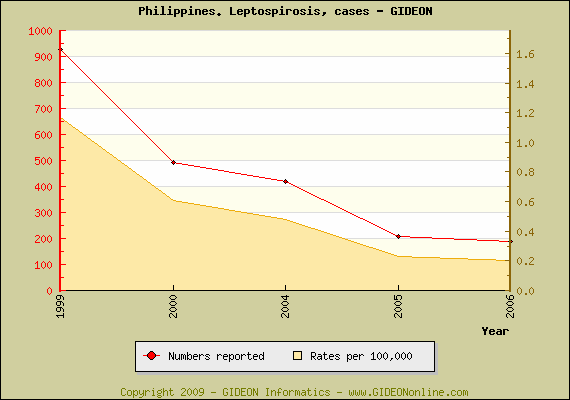
A recent outbreak in Manila belies the fact that reported rates of leptospirosis in the Philippines had actually decreased in recent years. See graph:
The following additional background data are abstracted from GIDEON www.GideonOnline.com (primary references available on request):
Leptospirosis was first reported n the Philippines in 1932.
– 65 cases were documented in literature published during 1932 to 1970; 390 during 1971 to 1973; approxomately 840 during 1998 to 2001.
– Leptospirosis is common in flood-prone areas of urban setting such as Metro Manila.
– The average age of patients is 32 years, 87% of cases were males and 70% are outdoor workers.
– The case fatality rate is 12 to 14 percent.
– Rates in Cabatuan, Iloilo are estimated at 147 cases per 100,000 population (2007 publication).
Prevalence surveys:
5% of aseptic meningitis cases in Manila (1989 publication)
Seroprevalence surveys:
43.6% of rice farmers in Central Luzon (1988 publication)
0% of dogs (RMAT, 1970 to 1973)
The following serovars of Leptospira interrogans have been demonstrated among patients in the Manila area: poi, tarassovi, manilai, pyrogenes, australis, grippotyphosa, javanica and automnalis.
Notable outbreaks:
1976 to 1983 – An outbreak of leptospirosis was reported on a penal farm in Sablayan, Mindoro.
1999 – An outbreak (17 cases) of leptospirosis involved participants in an ‘iron-man contest’ – from Germany, Hong Kong and the Philippines.
Update: Posted in ProMED
September 29th 2009
Trichinellosis in Lithuania
A recent outbreak in Vilnius reminds us that Lithuania had reported the highest rates of trichinellosis in the Baltic region until 1999. Since 2000, disease rates in the area have been similar.
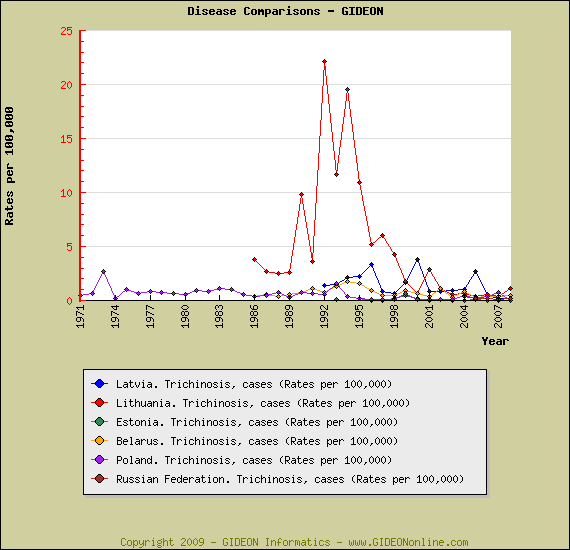
(This chart was generated using a user-driven Gideon menu, which contains over 35,000
base graphs.)
September 24th 2009
Ross River Disease – Northern Territory
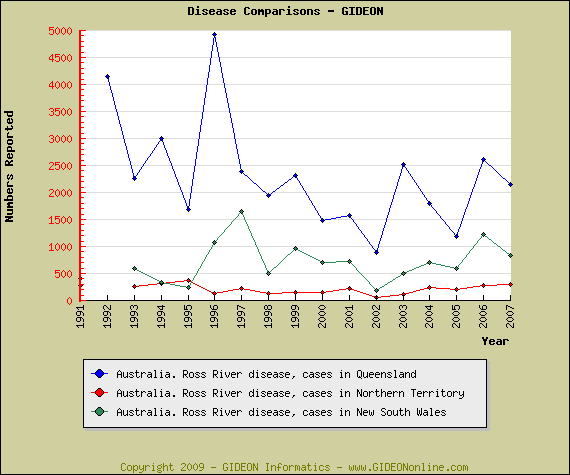
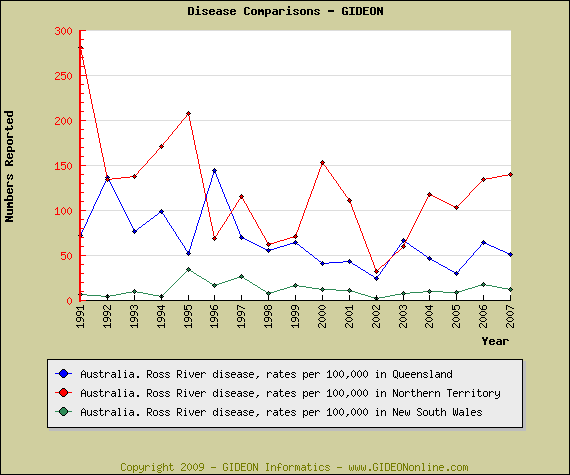
A recent outbreak in Australia serves as a classic exercise in Epidemiology. Although Queensland and New South Wales account for most cases of Ross River disease, rates per 100,000 are consistently highest in Northern Territory.
Update: Referenced in ProMED
August 17th 2009
Brucellosis in Mexico
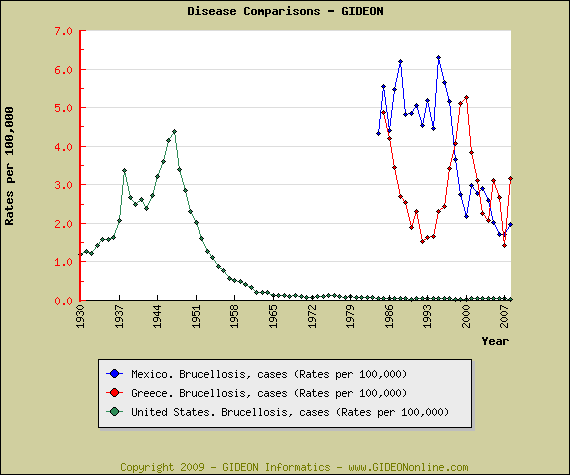
A recent outbreak in Guanajato reminds us that brucellosis remains a very common disease in Mexico. In fact, current rates are comparable to those of Greece, and similar to rates that existed in the United States during the 1930’s and 1940’s. See graph:
The following background data on brucellosis in Mexico are abstracted from Gideon
Time and Place:
– Highest rates are found in Queretaro, Coahuila, Guanajuanto, Nuevo Leon, Chicuahua, Jalisco, Tamaulipas and Michoacan.
– 163 fatal cases were reported during 1978 to 1982
– Mortality rates were 0.04 per 100,000 in 1992; 0.01 per 100,000 in 1996 .
Seroprevalence surveys:
3.42% nationwide, ranging from 0.24% in Morelos, to 13.5% in Mexico State (1992 publication)
0.71% of blood donors in northeastern Mexico (2009 publication)
0.238% of equines in Tamaulipas (Brucella abortus, 2006 publication)
9.8% of goats on farms (Brucella melitensis). (Michoacan, 2007 publication)
Infecting species:
– Brucella melitensis, B. abortus and B. canis are found in Mexico.
– The predominant species is Brucella melitensis. (1968 to 1991)
Reservoirs:
– The caprine seropositivity rate was 20.7% in 1947.
– Highest rates of caprine disease are reported in Coahuila, Chihuahua, Jalisco and Zacatecas.
– Highest rates of bovine disease are reported in Chihuahua, Hidalgo and Guanajuato.
– 11.8% of stray dogs in Mexico City are infected by Brucella canis.
Vehicles:
– Most infections are acquired from unpasteurized milk, fresh cheese and other dairy products – primarily from goats (There are over 9 million goats in Mexico).
– More than 35% of cow milk is consumed unpasteurized – more than 85% of goat milk.
Update: Posted in ProMed
August 1st 2009
Rocky Mountain Spotted Fever – Fatal
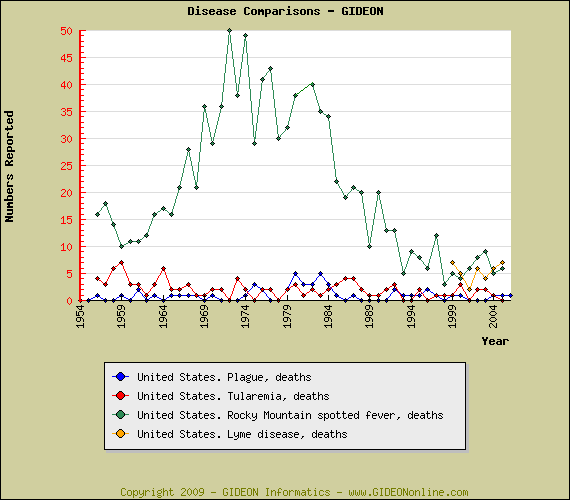
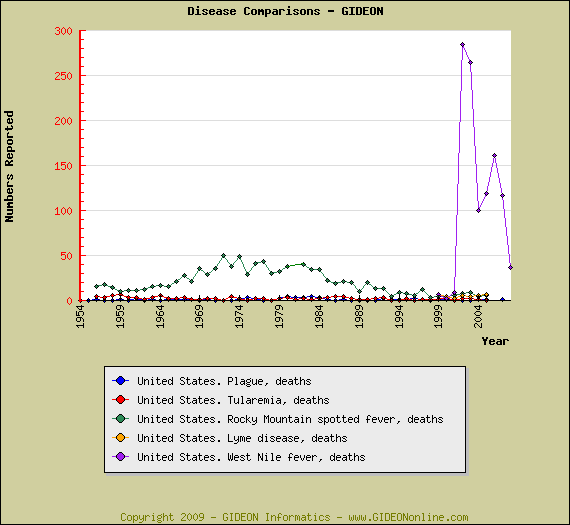
Regarding reports of a fatal case in Minnesota, Rocky Mountain spotted fever (RMSF) was the most common cause of arthropod-associated death in the United States for many years; but this “distinction” is now held by West Nile fever.
July 17th 2009
Common Travel Illnesses
 Following up on The Ten Worst Travel-Related Diseases post, Terry Ward at Forbes Travel interviewed Dr. Steve Berger for her article, 8 most common travel illnesses. Steve spoke about diarrhea:
“It’s very hard to avoid. About 40 percent of people will get diarrhea when traveling in an undeveloped country, which covers most of the world,” says Dr. Stephen Berger, founder and medical advisor for GIDEON, an online infectious diseases database. Exposure to different strains of the E. coli bacteria, present in all of our bodies, says Berger, is what usually causes diarrhea in travelers, and it can happen in any country.
… referenced chikungunya:
“And with the chikungunya outbreak in Italy in 2007, that’s not tropical any more either,” says Dr. Berger, referring to another mosquito-borne illness that manifests with terrible joint pain, muscle pain, a fever, and often a rash. An outbreak in Ravenna, Italy, in 2007 showed the disease was spreading beyond the tropical realm. “The mosquitoes that cause these things turn out to be mosquitoes that also invade non-tropical areas,” says Berger, “Chikungunya is extremely common in the Indian Ocean region, and it’s becoming more and more common to see it in travelers in the U.S. and Europe, too.”
and more.
Read both the article and the slide show.