The following background information on Bartonellosis in Peru is abstracted from Gideon and the Gideon e-book series. [1] Primary references are available on request.
Seasonality / Distribution:
– South American bartonellosis is primarily found in the Western Andes river valleys at elevations of 500 to 3000 meters – Ancash, La Libertad, Cajamarca and Amazonas.
– Cases are reported at elevations as high as 3,375 meters (town of Huasta).
– During 2004 to 2007, 36.1% of cases were reported from Cajamarca, 30.3% Ancash, 17.3% La Libertad and 8.0% Amazonas
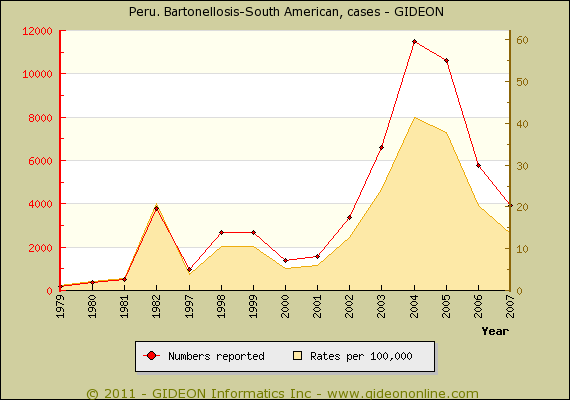
Indidence – see graph:
Chronology:
1871 – 7,000 workers died of bartonellosis during the building of a railway line from Lima to Oroya. (thus the term, “Oroya fever.”)
1906 – An outbreak (200 fatal cases) was reported among tunnel workers.
1959 – An outbreak (200 fatal cases) was reported in Anco.
2003 – 31 fatal cases were reported. 3,431 cases were reported in Ancash and 1,220 in La Libertad.
2004 – 4,087 cases were reported in Jaen and 3,979 in Ancash.
2007 – 1,857 cases (12 fatal) of acute infection 584 of chronic infection were reported.
2011 – A fatal case was reported in the Lambayeque region.
1987 – An outbreak (554 cases, 14 fatal) was reported in Shumpillan Village (Pomabamba Province).
1998 – Outbreaks were reported in new focus in the Urubama region (20 cases), and in Cuzco Department.
2006 – An outbreak (10 cases) was reported in a new focus in Arahuan District, Lima Province.
Vectors:
– The local sand-fly vector is Lutzomyia verrucarum.
– L. maranonensis and L. rubusta have also been implicated.
Reference:
1. Berger SA. Infectious Diseases of Peru, 2011. 401 pp, 92 graphs, 1,282 references. Gideon e-books, https://www.gideononline.com/ebooks/country/infectious-diseases-of-peru/