Tick-borne encephalitis was first reported in Hungary in 1977. [1,2] The disease is most common in forested, hilly areas of the western and northern regions. Highest incidence is reported from western Hungary, west of the Danube; the region surrounding the Balaton extending to the Austrian and Croatian borders; the areas to the west and north of Budapest, along the border to the Slovak Republic.
High rates are reported in the areas surrounding Zala, Somogy, Vas (western Hungary) and Nograd (northern Hungary). Sporadic cases occur on the river Theil, the areas east of Miskolc. Disease rates correlate with proximity to a forested habitat within a 2500-meter radius of a town or village.
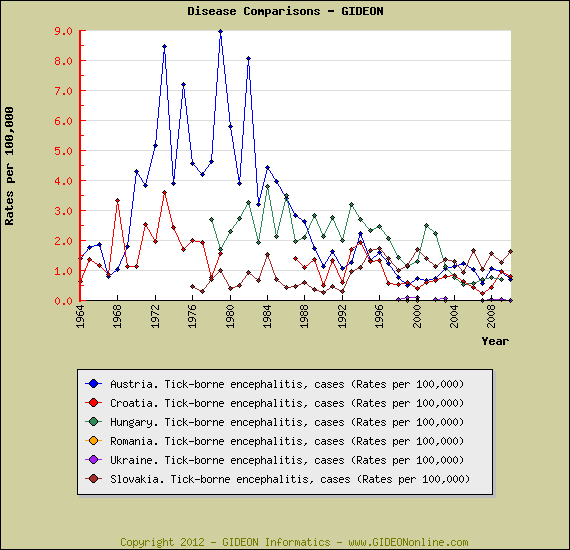
The incidence of TBE in Hungary has decreased somewhat since the 1990’s and continues to be similar to those of bordering countries – see graph. [3]
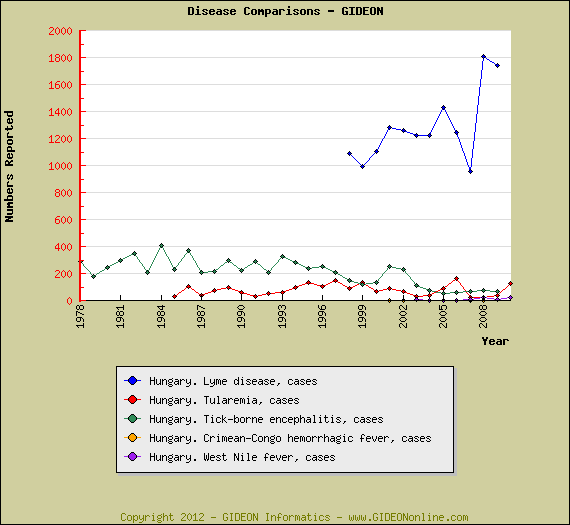
The second graph compares the incidence of TBE with those of other arthropod-borne diseases in Hungary.
Seroprevalence surveys:
26.5% of cattle, 7.0% of sheep, and 0.0% of horses in northeastern Hungary (2008 publication)
Notable outbreaks:
2007 – An outbreak (25 cases) was associated with consumption of raw goat milk.
References:
1. Berger SA. Infectious Diseases of Hungary, 2012. 406 pp, 131 graphs, 1336 references. Gideon e-books, https://www.gideononline.com/ebooks/country/infectious-diseases-of-hungary/
2. Berger SA. Tick-borne Encephalitis: Global Status, 2012. 57 pp, 45 graphs, 429 references. Gideon e-books, https://www.gideononline.com/ebooks/disease/tick-borne-encephalitis-global-status/
3. Gideon graph tool at https://www.gideononline.com/wp-content/uploads/Gideon-Graphs.pps