The following background data are abstracted from Gideon www.GideonOnline.com and the Gideon e-book series. [1,2]
Time and Place:
Although “chigger fever” may have been described in China as early as 313 C.E., the disease was first reported in Kunming (Yunnan Province) in 1942. Foci of scrub typhus exist in Jiangsu, Liaoning, Shandong, Fujian, Zhejiang, Jiangsu, Jelin, Jenan, Heilongjiang, Hainan, Hunchun, Tibet, Hang Zhou City and Tianjin City. The disease was first reported in Hubei Province in 1997. Newly-discovered foci were reported in the Nan Peng Lie Islands in 2002 and in Fuyang City, Anhui Province in 2008.
Epidemics occur approximately every 20 years, with variable clinical severity (the most severe disease reported from Shanxi Province). In most of the country, cases tend to appear in May 14 , peak during June and July, and decrease in August. Peak incidence in Sichuan and Yunnan occurs in August; September to November in Shandong. Most cases of scrub typhus in Hong Kong are reported in adults, and during the summer and fall.
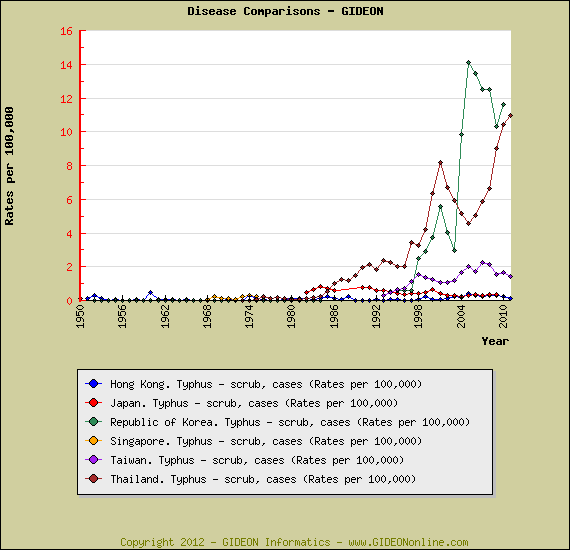
Yearly incidence data are not available for China as a whole; however, reports from Hong Kong and other regional countries suggest that rates of scrub typhus have been increasing since the 1980’s – see graph [3]
Additional geographic notes:
Fujian – Over 1% of persons on Pingtan Island developed scrub typhus during the 1950’s, with a case-fatality rate of 13.6%. 28 cases were reported on the island during 2000 to 2005.
Guangzhou – Over 500 cases were reported during 1952 to 1954, 5.4% fatal.
Hainan – Over 10,000 cases were reported during 1956 to 1985.
Hong Kong – 136 cases (0 fatal) of scrub typhus were reported in Hong Kong during 1999 to 2008
Shandong – 1,291 cases were reported during 2006 to 2010 – 49.5% above age 55, and m/f = 1/1.02. 480 cases were reported from Feixian County during 1995 to 2006; and 56 cases of pediatric infection were reported in Fei County during 1993 to 2004.
Prevalence surveys:
16.13% of mice in Xinyang, Henan Province (2007 publication)
Seroprevalence surveys:
36.1% of healthy persons in Xinjiang Uygur Autonomous region (1980’s)
31.8% of persons on Hainan Island (1983)
6.3% of healthy farmers in Yiyuan County, Shandong Province (2005 to 2007)
1.8% to 39.8% of farm workers near Tianjin (2007 to 2009)
Reservoirs:
The local reservoirs are Rattus flavipectus, R. niviventer, R. losea, R. rattus, R. norvegicus, R. confucianus and Apodemis agrarius. Rodents and mites coinfected by Hantavirus and Orientia tsutsugamushi have been identified in endemic areas. A known mite vector, Leptotrombidium scutellare, has been identified on 30 species of rodents in Yunnan.
Vectors:
The local vectors are Leptotrombidium pallidum, L. deliense (Hong Kong), L. scutellare (Shandong Province and Yunnan Province) and L. gaohuensis (Zhejiang Province). L. intermedium has also been identified as a possible vector.
Published outbreaks:
1986 – An outbreak (138 cases) of scrub typhus was reported in Menying County, Shandong Province.
2007 (publication year) – An outbreak (19 cases) was reported in Henan Province.
References:
1. Berger SA. Infectious Diseases of China, 2012. 685 pages, 261 graphs, 3848 references. Gideon e-books, https://www.gideononline.com/ebooks/country/infectious-diseases-of-china/
2. Berger SA. Australo-Asian Spotted Fevers: Global Status, 2012. 41 pages, 14 graphs, 392 references, Gideon e-books, https://www.gideononline.com/ebooks/disease/australo-asian-spotted-fevers-global-status/
3. Gideon Graph Tool, see tutorial at https://www.gideononline.com/wp-content/uploads/Gideon-Graphs.pps
Note featured on ProMED