The following background data on botulism in Argentina are abstracted from the Gideon e-book series. [1,2]
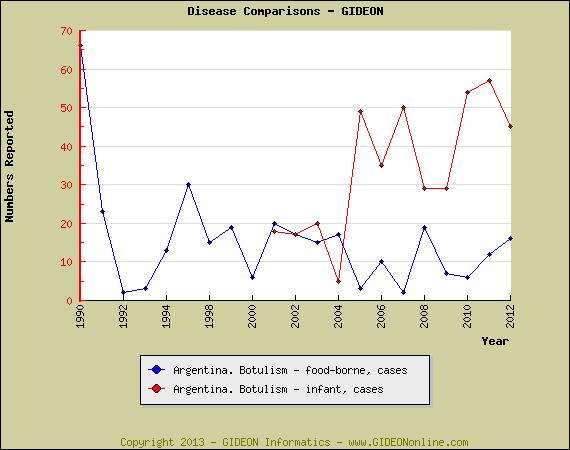
Most cases of botulism in Argentina are related to home-canned vegetables, airtight packed food with inappropriate refrigeration, and aerosols. Rates of food-borne botulism have remained fairly constant for the past 20 years, and as in many other countries are exceded by those of infant botulism – see graph [3] Virtally all cases of infant botulism have been caused by type A botulinum toxin.
Prevalence surveys (Clostridium botulinum spores):
7.5% of commercial chamomile tea samples (Mendoza, 2008 publication)
1.1% of rural commercial honey samples (Mendoza and San Luis Provinces, 1997 publication)
14.6% of soil samples in Entre Rios (2003 publication)
23.5% of soil samples from five regions (2005 publication)
Linden flower (Tilia spp) tea, a household remedy used as an infant sedative, has also been implicated as a source of Clostridium botulinum.
A single case report of wound botulism was published in 2000.
Notable outbreaks:
1920 to 1926 – Two outbreaks (total 8 cases) of botulism were reported.
1974 – An outbreak (11 cases, 3 fatal) was ascribed to cheese spread.
1979 – An outbreak (9 cases) was ascribed to home-canned vegetables.
1982 – An outbreak (1 case) in Mendoza was ascribed to pickled trout.
1998 – An outbreak (9 cases, none fatal) of type A botulism among Buenos Aires bus drivers was ascribed to matambre (meat roll).
2011 – An outbreak (2 cases) was reported among members of a family from Chile who had eaten in a restaurant in Argentina.
References:
1. Berger SA. Infectious Diseases of Argentina, 2013. 447 pages, 103 graphs, 2145 references. Gideon e-books, https://www.gideononline.com/ebooks/country/infectious-diseases-of-argentina/
2. Berger SA. Botulism: Global Status, 2013. 85 pages, 90 graphs, 645 references. Gideon e-books, https://www.gideononline.com/ebooks/disease/botulism-global-status/
3. Gideon Graph Tool, see tutorial at https://www.gideononline.com/wp-content/uploads/Gideon-Graphs.pps
Note featured in ProMED