The following background data on Q-fever in Spain are abstracted from Gideon www.GideonOnline.com and the Gideon e-book series. [1,2]
Time and Place:
The first cases of Q-fever in Spain were reported in 1950. Q-fever rates are highest in the Basque region (accounting for 60% of community-acquired pneumonias) and Navarre. Pneumonia is the predominant clinical presentation in the north, and hepatitis in the south. Ten outbreaks were registered during 1981 to 1985. 130 cases of Q-fever were reported in the Basque Country during 1981 to 1984; and 1,261 cases in Gipuzkoa (Basque Country) during 1984 to 2004.
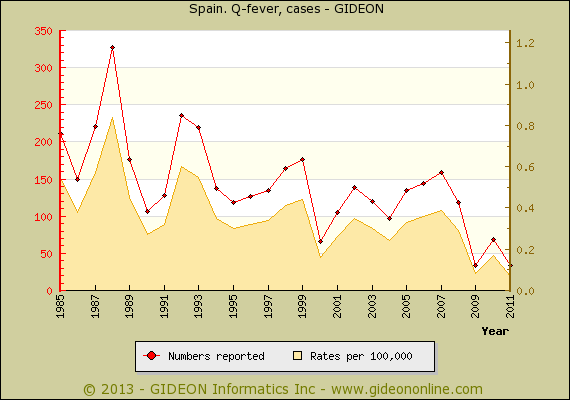
Rates of Q-fever in Spain have been decreasing for over 25 years – see graph:
Prevalence surveys:
5% of community-acquired pneumonia in Palma de Mallorca (1992 to 1994)
18.5% of community-acquired pneumonia (2006 to 2007)
30% of patients with fever exceeding 7 days
20.1% of women with spontaneous abortion vs. 9.7% of controls (Burgos, 2009 to 2010)
13.7% of patients hospitalized with fever lasting 1 to 4 weeks (Grenada, 2000 to 2005)
3% of ovine flocks in northern Spain (1999 to 2003)
22% of sheep flocks in the Basque Country (2009 publication)
5.1% of roe deer (Capreolus capreolus), 4.3% of wild boar (Sus scrofa), 9.1% of European hare (Lepus europaeus), 11% of vultures (Gyps fulvus) , 14% of black kites (Milvus migrans) and 0% of associated ticks (Basque region, 2010 publication)
Coxiella burnetii has been detected in ticks (Haemaphysalis punctata) in the Basque Country (2003 to 2005)
Seroprevalence surveys:
50% of persons in rural Soria Province (1996 to 1999)
38.5% of adults in the rural Basque Country (1993 publication)
40.6% of adults in Leon Province (1996 publication)
48.6% of adults in Eastern Cantabria (1998 publication)
10.02% to 11.02% of veterinary students in Zaragoza (2000 publication)
15.3% of the population of Valles Occidental (2006 publication)
23.1% of blood donors in Albacete (2007 publication)
11.8% of sheep, 8.7% of goats and 6.7% of beef cattle in semi-extensive grazing systems in northern Spain (2010 publication)
30% of herds and 6.76% of cattle in the Madrid region (2012 publication)
Notable outbreaks:
1982 – An outbreak (42 cases) of Q-fever was reported in Valmaseda, Basque region.
1990 – An outbreak (30 cases) was reported in Billabona and Zizurkil, Guipuzcoa.
1998 – An outbreak (14 cases) related to sheep was reported in Soria Province.
2003 – An outbreak (60 cases) was reported in Asturias.
2006 (publication year) – An outbreak (22 cases) was associated with a visit to a school farm.
2012 (publication year) – An outbreak was reported in flock of sheep.
References:
1. Berger SA. Infectious Diseases of Spain, 2013. 575 pages, 194 graphs, 3284 references. Gideon e-books, https://www.gideononline.com/ebooks/country/infectious-diseases-of-spain/
2. Berger SA. Q-fever: Global Status, 2013. 78 pages, 58 graphs, 1035 references. Gideon e-books, https://www.gideononline.com/ebooks/disease/q-fever-global-status/
Note featured on ProMED