The following background data on Parvovirus B19 infection in the United Kingdom is abstracted from Gideon www.GideonOnline.com and the Gideon e-book series. [1,2]
Parvovirus B19 (Erythrovirus B19) was first discovered in England in 1974, among serum specimens from healthy blood donors.
– Highest rates are reported during spring and early summer.
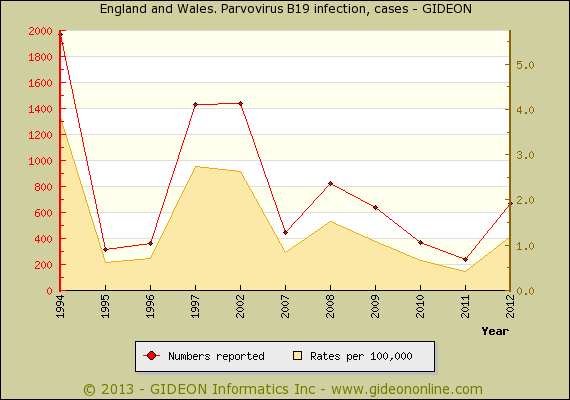
– Epidemics are reported every 4 to 5 years – the last occurring during 1997 to 1998.
– Infection is estimated to occur in 1:512 pregnancies, and may account for as many as 150 fetal deaths annually (26% of viruses associated with fetal death)..
The following graph illustrates annual incidence and disease rates per 100,000 population:
Seroprevalence surveys:
45% by age 10 years and 70% by age 60 (England)
21% by age 4 years and >75% over 40 years (England 1996)
62% of women in child-bearing age – 0.69% acquired parvovirus during their pregnancy (2007 publication)
66.5% of women of child-bearing age (Northern Ireland, 2012 publication)
81% of patients with rheumatoid arthritis and 77% of patients with osteoarthritis (Northern Ireland, 1995 publication)
21% of HIV-positive patients and 0% of HIV-negative controls (Northern Ireland, 1997 publication)
Notable outbreaks:
1983 – An outbreak (36 cases) of erythema infectiosum was reported at a school in north London.
1985 (publication year) – An outbreak of erythema infectiosum was reported in Bristol.
1985 – An outbreak of concurrent influenza and Parvovirus B19 infections was reported in a boys’ boarding school.
1987 – An outbreak (97 cases) of erythema infectiosum was reported at a primary school in Bury, Lancashire.
1989 (publication year) – An outbreak (54 cases) of erythema infectiosum was centered at a junior school.
1992 (publication year) – An outbreak (12 cases) of erythema infectiosum was reported among staff and patients on a children’s ward.
1992 – An outbreak (18 cases) of erythema infectiosum was reported among adult patients on a hospital ward in London.
1996 (publication year) – An outbreak of erythema infectiosum was reported at a primary school.
References:
!. Berger SA. Parvovirus B19: Global Status, 2013. 27 pages, 9 graphs, 289 references. Gideon e-books, https://www.gideononline.com/ebooks/disease/parvovirus-b19-global-status/
2. Berger SA. Infectious Diseases of the United Kingdom, 2013. 1106 pages, 946 graphs, 3801 references. Gideon e-books, https://www.gideononline.com/ebooks/country/infectious-diseases-of-the-united-kingdom/