The following background data on Lyme disease in the United Kingdom were abstracted from Gideon www.GideonOnline.com and the Gideon e-book series. [1,2] Primary references are available on request.
Time and Place:
Lyme disease is reported from East Anglia, Scotland, Wales, Yorkshire and Northern Ireland. Highest incidence is associated with popular holiday destinations such as Exmoor, the New Forest, the South Downs, parts of Wiltshire and Berkshire, Thetford Forest, the Lake District, the Yorkshire moors and the Highlands and Islands of Scotland. “Hot spots” for the disease include the New Forest and the Southwest region. 45% of reports originate in three contiguous counties in southern England: Hampshire, Wiltshire and Dorset. This area includes foci in and near the New Forest and Salisbury Plain. Other counties with a relatively high incidence include Devon and Somerset in southwestern England; and Norfolk in East Anglia.
Incidence:
Reporting rates in the United Kingdom are approximately 39% of true incidence (2011). Case reports peak in the third quarter of each year, which accounts for 48% of all cases.
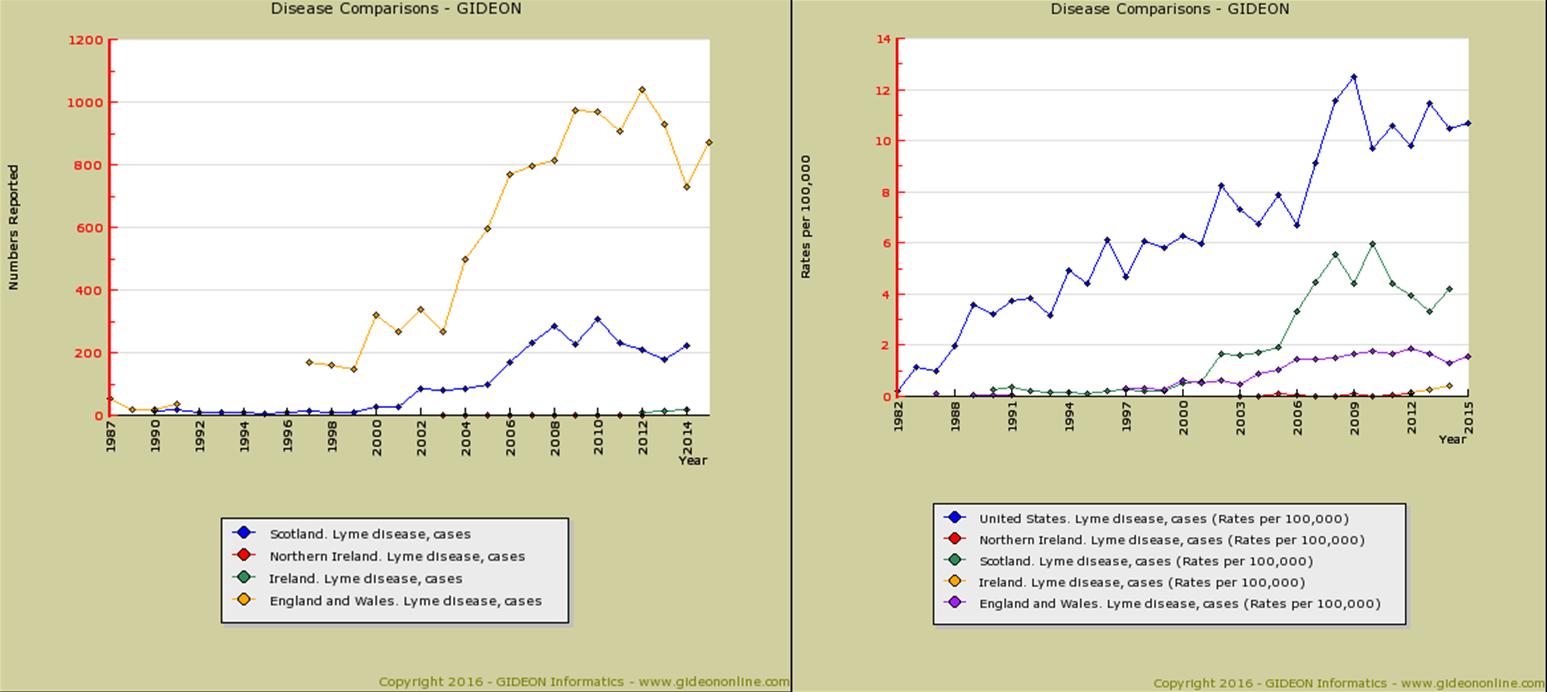
In the following graphs, I’ve contrasted case numbers and rates per 100,000 in the United Kingdom, with those reported in Ireland and the United States. Note that highest disease incidence in the United Kingdom is reported from England and Wales; and highest rates per 100,000 from Scotland. Reported rates in the United States are approximately 2.5-fold those of Scotland.
Infections due to Borrelia burgdorferi, B. afzelii and B. garinii are identified.
Borrelia valaisiana and B. afzelii have been identified in ticks in Scotland.
Prevalence surveys:
23% of patients referred to an infectious disease unit for suspected Lyme disease (2006 to 2010)
2.3% of dog ticks in the United Kingdom (2009)
4.2% of ticks (Ixodes ricinus) in England (2014 publication)
0.5% of pet-dog ticks (2012 publication)
0% of tick larvae, 2.14% of nymphs and 0% of adults in South London parks (2015 publication)
8.6% of ticks in the Scottish Highlands (both B. afzelii and B. burgdorferi, 1997)
37% of ticks in wooded areas of southern Wales
8.6% of Highland ticks in Scotland (Borrelia burgdorferi, 1997)
5.6% of questing tick nymphs in Scotland (Borrelia burgdorferi, 2012 publication)
11.9% of grey squirrels in Scotland (Sciurus carolinensis, 2015 publication)
Seroprevalence surveys:
2.5% to 4.0% of blood donors in South England
0% to 0.5% of blood donors in the inner-city
25% of forestry workers in endemic areas (1989 publication)
14.3% of farmers in Northern Ireland (1990 publication)
6.5% of individuals in the Scottish Highlands (2004 to 2006)
23% of wild deer in England and Wales (2012 publication)
Reservoirs:
Grey squirrels (Sciurus carolinensis Gmelin) and pheasants (Phasianus colchicus Linneaus) 18 are important hosts for Ixodes ricinus, and may serve as amplifying hosts for Borrelia burgdorferi in this country.
Seropositive horses are found in most parts of the U.K.
Note featured on ProMed
References:
1. Berger SA. Lyme Disease: Global Status, 2016. 87 pages, 67 graphs, 1037 references. Gideon ebooks, https://www.gideononline.com/ebooks/disease/lyme-disease-global-status/
2. Berger SA. Infectious Diseases of the United Kingdom, 2016. 1317 pages, 971 graphs, 4,932 references. Gideon ebooks,
https://www.gideononline.com/ebooks/country/infectious-diseases-of-the-united-kingdom/