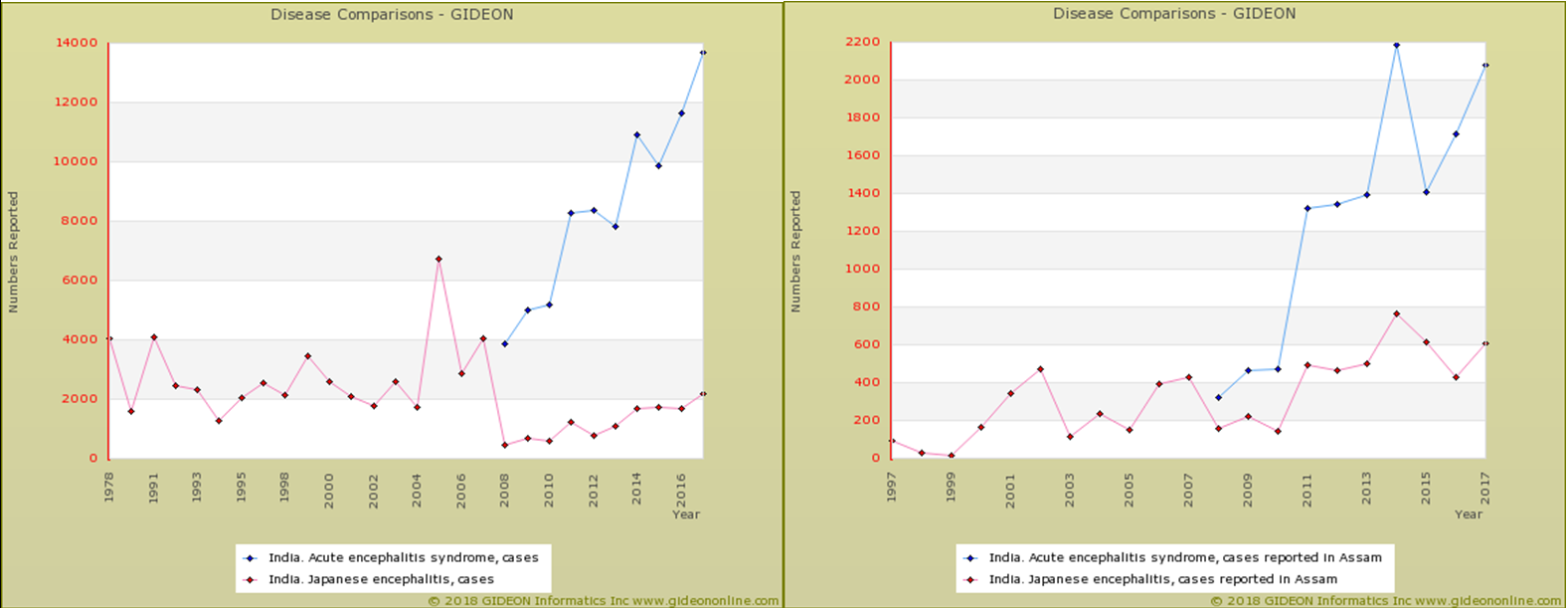
Since 2008, data regarding Japanese Encephalitis in India have distinguished between Japanese encephalitis [JE] and Acute encephalitis syndrome [AES]. Cases of the latter have been variously ascribed to Chandipura, enteroviral infection, scrub typhus and lychee fruit intoxication. [1,2] In 1963, 22% of individuals in Assam (Lakhimpur and Darrang districts) were seropositive toward JE virus. Surveys conducted during 2006 to 2014 found that Japanese encephalitis was responsible for 30% to 78% of acute encephalitis cases in Assam. A study published in 2007 found that 19.3% of patients with Japanese encephalitis in Assam State have concurrent neurocysticercosis. In the following chart, I’ve compared reported incidence for these two conditions in India and in Assam State. [3]
References:
- Berger SA. Japanese Encephalitis: Global Status, 2018. 96 pages , 66 graphs , 1,120 references Gideon e-books, https://www.gideononline.com/ebooks/disease/japanese-encephalitis-global-status/
- Berger SA. Infectious Diseases of India, 2018. 585 pages , 96 graphs , 6,487 references. Gideon e-books, https://www.gideononline.com/ebooks/country/infectious-diseases-of-india/
- Gideon e-Gideon multi-graph tool, https://www.gideononline.com/cases/multi-graphs/
Note featured on ProMED