GIDEON blog

Free Demo ► Latest Updates ► Video Tutorials ►
Subscribe , j x

Toxoplasmosis in Australia and New Zealand

The following background notes on toxoplasmosis in Australia and New Zealand are abstracted from Gideon www.GideonOnline.com and the Gideon e-book series. [1-3]

Australia:
An estimated 520 to 650 babies are born with congenital toxoplasmosis each year.

Prevalence surveys:
3.7% of encephalitis cases in Australia (221 cases reported, 1990 to 2007)

Seroprevalence surveys:
35% of pregnant women in Western Australia; 23% to 45% in Melbourne; 23% in South Australia; 26% in Queensland
50% of feral cats in Tasmania (1997 publication)
67% of captive common brushtail possums (Trichosurus vulpecula, 2008 publication)
15.5% of Western grey kangaroos in the Perth region (2009 publication)
5% of wild brush-tailed rock-wallaby populations in southeast Queensland (2010 publication)
0% of Australian fur seals (Arctocephalus pusillus doriferus, 2007 to 2009)

Cases of human infection have been ascribed to ingestion of poorly-cooked kangaroo meat.

High abortion rates are reported among pregnant Tasmanian ewes, which are infected through ingestion of cat feces.
– Toxoplasmosis has been demonstrated among humpbacked dolphins (Sousa chinensis) stranded in Queensland; and in common wombats (Vombatus ursinus)
– Toxoplasmosis has been reported in kakariki (Cyanoramphus spp.)

Notable outbreaks:
1984 (publication year) – An outbreak (5 cases) of toxoplasmosis among members of a Lebanese family in Australia was ascribed to contaminated Kibbi (a traditional meat dish)

New Zealand:
164 primary maternal infections are estimated annually, with resultant infection of 66 fetuses.
– The maternal seroconversion rate is 0.62% per year.

Seroprevalence surveys:
33% of pregnant women in Auckland (IgG, 2000)
42.9% of healthy blood donors in Waikato (2007 publication)
85% of ewes (2006 to 2009)

Toxoplasmosis has been documented in wallabies (Macropus eugenii, Macropus rufogriseus) exported to the United States from New Zealand.

References:
1. Berger SA. Infectious Diseases of Australia, 2011. 503 pp, 158 graphs, 2460 references. Gideon e-books, https://www.gideononline.com/ebooks/country/infectious-diseases-of-australia/
2. Berger SA. Infectious Diseases of New Zealand, 2011. 399 pp, 132 graphs, 1199 references. Gideon e-books, https://www.gideononline.com/ebooks/country/infectious-diseases-of-new-zealand/
3. Berger SA. Toxoplasmosis: Global Status, 2011. 92 pp, 74 graphs, 950 references. https://www.gideononline.com/ebooks/disease/toxoplasmosis-global-status/

Botulism in Germany

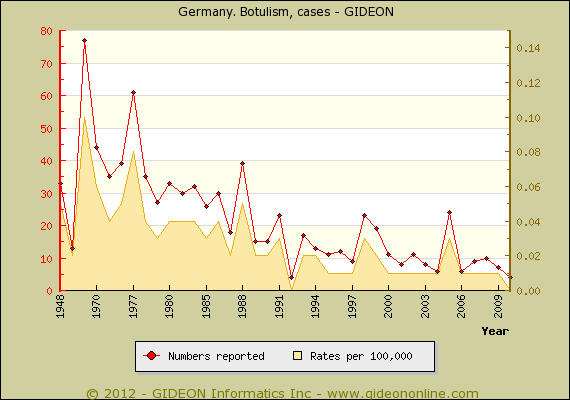
Rates of botulism in Germany have changed little since the 1980’s – as depicted in the following graph: [1, 2].

Of historic interest, the world’s first botulism outbreak was reported in this country. In 1793, thirteen residents of Wildbad acquired the disease from tainted sausage – thus the term “botulism” (Latin, botulus = sausage). [1,2]

References:
1. Berger S. Infectious Diseases of Germany, 2011. 488 pp, 145 graphs, 1906 references. Gideon e-books, https://www.gideononline.com/ebooks/country/infectious-diseases-of-germany/
2. Berger S. Botulism: Global Status, 2011. 80 pp, 86 graphs, 510 references. Gideon e-books, https://www.gideononline.com/ebooks/disease/botulism-global-status/

The Rickettsial Diseases of Mexico

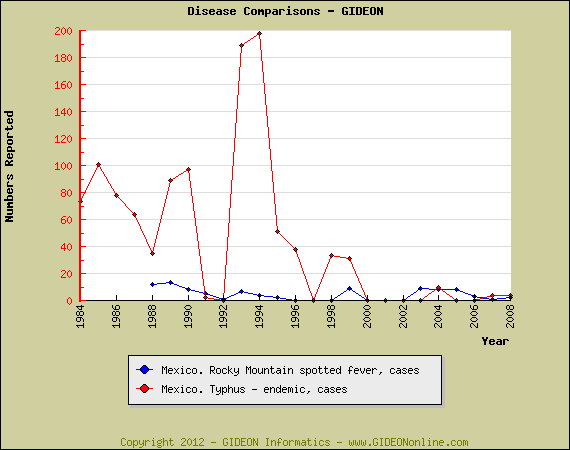
Although the “rickettsiosis” reported in Michoacan could represent Rocky Mountain spotted fever, the extent and location of this outbreak suggests a diagnosis of Endemic typhus. In the following graph, I’ve compared the incidence of these two diseases in Mexico.

In fact, six Rickettsiae (including Coxiella burnetii, a related taxon) are reported in Mexico. The following summary is abstracted from Gideon www.GideonOnline.com and references 1-3. (primary references available on request)

Rickettsia felis:
Rickettsia felis infection was first identified in the Yucatan in 1996, where the organism has subsequently been identified in both humans and fleas.
– Infected fleas have also been recovered from flying squirrels in Mexico.
– Four cases were documented in the Yucatan to 2006.
– Eight cases (3 fatal) of “spotted fevers” were reported in the Yucatan during 2006 to 2007.
Prevalence surveys:
20% of Ctenocephalides felis fleas in Yucatan (2002 publication)
Seroprevalence surveys:
5% of healthy persons in Yucatan (1999)

Epidemic typhus:
– 7,353 fatal cases of epidemic typhus were reported during 1893 to 1907.
– 1,220 cases (707 fatal) were reported during 1939 to 1943.
– The average incidence during 1959 to 1961 was 146 cases per year.
– 64 cases (14 fatal) were reported during 1960 to 1963.
– A total of three outbreaks were reported during the 1980’s – two in Chiapas and one in Mexico State.
Prevalence surveys:
0% of body lice from prisoners and homeless persons in Mexico City (2009 publication)
Notable outbreaks:
1951 – An outbreak (737 fatal cases) was reported.
1966 – An outbreak (10 cases, 0 fatal) was reported in Zoyatlan de Juarez.
1966 to 1967 – An outbreak (18 cases, 3 fatal) was reported in Minas Viejas (Mexico State).
1967 – An outbreak (40 cases, 1 fatal) in Atlacomulco, Mexico State, originated from a patient with Brill-Zinsser disease.
1983 – An outbreak (102 cases, 0 fatal) was reported in Mexico State

Endemic typhus:
Endemic typhus is reported in Guerrero, Hidalgo, Jalisco, Mexico, Michoacan, Nayarit, Nuevo Leon, Oaxaca, Puebla, Quertaro, Tamaulipas, Yucatan and Zacatecas States.
Seroprevalence surveys:
14% to 17% of blood donors in Mexico City (2004 publication)

Rocky Mountain spotted fever
In Mexico, this disease is known as fiebre machada.
– During 1930 to 1950, cases were reported from Coahuila, Durango, San Luis Potosi, Sinaloa and Sonora.
– Rocky Mountain spotted fever has been identified in the Yucatan since 2005.
– Cases continue to occur in Sonora as of 2010
– Mexico’s first fatal case was reported in the southwestern region in 2004.
– 52 cases were reported in Baja California during February to July, 2009.
Prevalence surveys:
40% of patients suspected of having dengue (Yucatan and Jalisco, 1993)
Seroprevalence surveys:
5.6% of persons in rural Yucatan are seropositive toward spotted fever-group rickettsiae (possibly the R. akari group, 1999 publication)
Vectors:
The local vector is Rhipicephalus sanguineus.
– Spotted fever-group rickettsiae have also been isolated from Amblyomma cajennense in Veracruz.
– Amblyomma imitator has been identified as a potential vector in Nueva Leon.
Notable outbreaks:
2009 – An outbreak (4 fatal cases) was reported in Baja California.

Rickettsialpox
– Two cases of rickettsialpox were documented in Yucatan in 2008.
– Evidence of canine infection has been reported in Yucatan (2009 publication)

Q fever:
Seroprevalence surveys:
2% of humans, 2% of cattle and 6% of goats and sheep (1952)
1.46% of cows (1950)
28% of the dairy cattle, 10% of beef cattle, 35% of goats and 40% of sheep (Nueva Leon, 2002 publication)

References:
1. Berger S. Infectious Diseases of Mexico, 2011. 446 pp, 128 graphs, 1,655 references. Gideon e-books, https://www.gideononline.com/ebooks/country/infectious-diseases-of-mexico/
2. Berger S. Endemic Typhus: Global Status, 2011. 65 pp, 90 graphs, 83 references. Gideon e-books,
https://www.gideononline.com/ebooks/disease/epidemic-typhus-global-status/
3. Graph tutorial at: https://www.gideononline.com/wp-content/uploads/Gideon-Graphs.pps

Note featured on ProMED

Brucellosis in Argentina

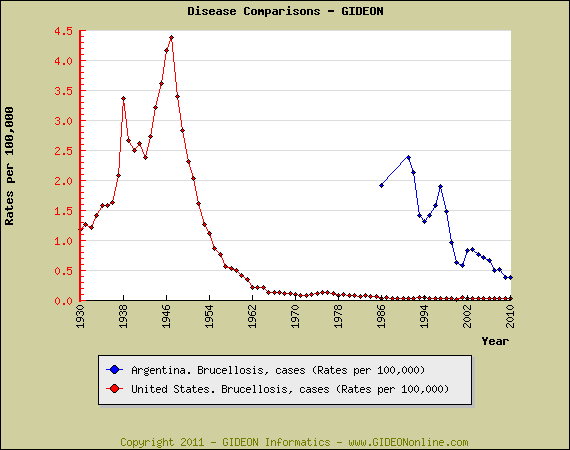
Rates of Brucellosis in Argentina have been decreasing for over two decades, but continue to parallel those reported in the United States during the 1950’s. [1,2] See graph [3]:

References:
1. Berger SA. Infectious Diseases of Argentina, 2011. 417 pp, 96 graphs, 1516 references. Gideon e-books, https://www.gideononline.com/ebooks/country/infectious-diseases-of-argentina/
2. Berger SA. Brucellosis: Global Status, 2011. 125 pp, 135 graphs, 717 references. Gideon e-books, https://www.gideononline.com/ebooks/disease/brucellosis-global-status/
3. Gideon graph tool tutorial at: https://www.gideononline.com/wp-content/uploads/Gideon-Graphs.pps

Note featured on ProMED

Rabies in Central America

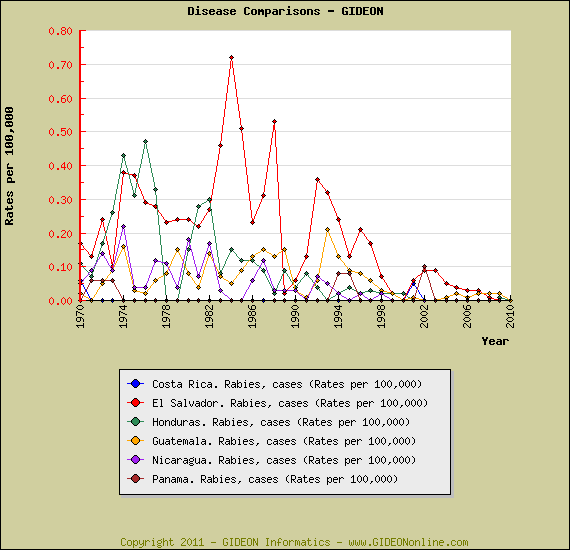
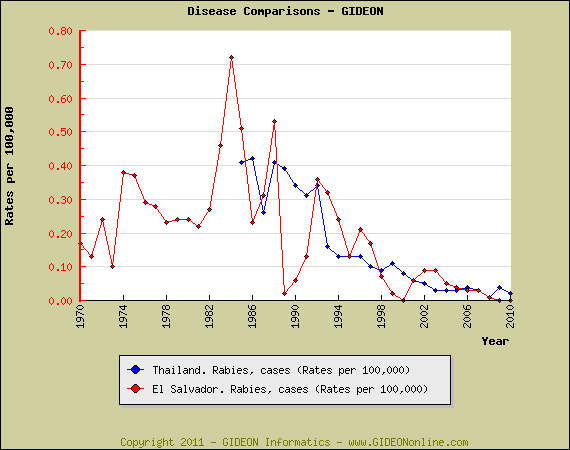
The incidence of human rabies in Central America has been decreasing since 1995. [1,2] Rates in El Salvador exceed those of other countries in the region, and are strikingly similar to those reported by Thailand. See graphs [3]:

References:
l. Berger SA. Infectious Diseases of El Salvador, 2011. 350 pp, 80 graphs, 883 references. Gideon e-books, https://www.gideononline.com/ebooks/country/infectious-diseases-of-el-salvador/
2. Berger SA. Rabies: Global Status, 2011 publication. 366 pp, 546 graphs, 1056 references. Gideon e-books, https://www.gideononline.com/ebooks/disease/rabies-global-status/
3. Graph tutorial at: https://www.gideononline.com/wp-content/uploads/Gideon-Graphs.pps

Hepatitis A in North America

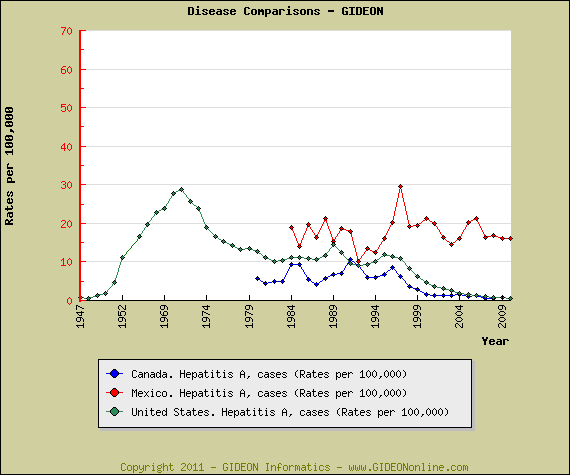
Notwithstanding a recent series of outbreaks, rates of Hepatitis A in Mexico have changed little since 1984, and remain similar to those reported in the United States during the 1960’s and 1970’s (see graph). [1-3]

References:
1. Berger SA. Infectious Diseases of Mexico, 2011. 446 pp, 128 graphs, 1655 references. Gideon e-book series, www.gideononline.com/ebooks/country/infectious-diseases-of-mexico/
2. Berger SA. Hepatitis A: Global Status, 2011. 163 pp, 180 graphs, 1073 references. www.gideononline.com/ebooks/disease/hepatitis-a-global-status/
3. www.GIDEONonline.com/wp/wp-content/uploads/Gideon-Graphs.pps
Featured in ProMED

Babesiosis in the United States

The following background data on babesiosis in the United States are abstracted from Gideon www.GideonOnline.com and the Gideon e-book series. [1,2] (primary references are available on request)

Time and Place:
Babesiosis was first diagnosed in the United States in 1968.
– Of 214 cases of babesiosis reported worldwide during 1975 to 1986, 200 occurred in the United States.
– Most cases are reported from Rhode Island , Massachusetts, New, Minnesota, New Jersey and Connecticut.
– Occasional cases are reported from Maryland, Virginia, New Jersey and Georgia.
– Highest incidence is reported during the warmer months.

Infecting species:
– Babesia microti accounts for most cases, but B. equi may cause human disease in California, and B. divergens in Missouri (implicated in a single, fatal case).
– Infection due to Babesia duncani has been reported in Washington State (Babesia WA1) , California (Babesia CA1 and WA1) and Missouri (Babesia MO1)
– Most infections due to these new species have occurred among splenectomized individuals; whereas 95% of B. microti infections are reported in persons with intact spleens.
– Human infection by a Babesia divergens-like strain has also been reported in Washington State.
– There is evidence that Babesia WA1 infection is not limited to the west coast region.

Additional Geographic Notes:

New York:
Babesiosis was first documented in New York State in 1975.
– Six cases (0 fatal) were reported on Long Island during a two-month period (1982 publication)
– 139 patients were hospitalized for babesiosis in New York State during 1982 to 1993 – nine of these infections were fatal.
– 560 cases were reported in the state to 2001.
– 371 cases were reported in the Lower Hudson Valley during 2001 to 2008, including 119 in 2008.
– Infection has also been documented in humans and ticks (Ixodes scapularis) in upstate New York.
– Three cases were reported New York City in 2000 – possibly acquired in Westchester County (an area not previously known to be endemic).

Massachusetts:
160 cases were reported in Nantucket, Massachusetts during 1969 to 1998.
– 1.6% of residents of Nantucket Island, Martha’s Vineyard and Block Island are seropositive toward Babesia divergens, and 4.5% toward B. microti.

Rhode Island:
Babesiosis was first identified (2 cases) in Rhode Island in 1994.
– 189 cases were reported in Rhode Island during 1998 to 2004, including 48 in 2004.
– Rhode Island averaged ca. 2 cases per year during 1994 to 1999.
– 140 cases were reported from Block Island during 1991 to 2000. The rate of symptomatic infection on the island is estimated at 516 per 100,000 per year.

Other:
40 cases of babesiosis were reported in New Jersey during 1993 to 2001.
– 32 cases were reported in Wisconsin during 1996 to 2005.
– The first case of babesiosis in Tennessee was reported in 2010.

Transfusion-related babesiosis
159 cases of transfusion-associated infection were reported during 1979 to 2009, involving 19 states : 21 during 1980 to 1997; 18 (5 fatal) during 2005 to 2007; 122 during 2000 to 2009.
– 16 cases of transfusion-related babesiosis were reported in New York City in 2002, 25 in 2003; 16 in 2004; 18 in 2005; 38 in 2006; 25 in 2007; 39 in 2008.
– 21 cases of transfusion-related babesiosis were reported in Rhode Island during 1999 to 2007.
– No cases of fatal babesiosis acquired through transfusion were reported in 1997; 1 in 1998; 0 during 1999 to 2004; 2 in 2005; 3 in 2006; 3 in 2007.
– Seroprevalence in blood donors on Shelter Island (Suffolk County, eastern Long Island) was 4.3 percent in May 1998.
– A case of transfusion-associated babesiosis was reported in California in 2007.
– A case of transfusion-associated Babesia duncani infection was reported in California in 2008.
– A case of fatal transfusion-associated babesiosis was reported in Delaware in 2009.
– 1.4% of blood donors from endemic areas in Connecticut (0.3% from non-endemic areas) were seropositive in 1999; 1.0% in 2000; 1.4% in 2001.
– A rare case of congenital babesiosis has been reported in New Jersey (2009 publication)

Exported cases:
2003 (publication year) – A Czech national acquired babesiosis while traveling in the United States.
2003 (publication year) – A Swiss national acquired B. microti infection in the United States.
2005 – Hong Kong reported it’s first case of babesiosis – imported from the eastern United States.
2009 – A Dutch traveler acquired concurrent babesiosis and Lyme disease following a trip to the United States.

Reservoirs and Vectors:
The vector in the northeast is Ixodes scapularis (I. dammini), and the usual reservoir is the white-footed mouse (Peromyscus leucopus).
– Enzootic transmission of Babesia divergens has been demonstrated among cottontail rabbits (Sylvilagus floridanus) on Nantucket Island, Massachusetts.

Enzootic transmission of Babesia divergens among cottontail rabbits (Sylvilagus floridanus) by Ixodes dentatus has been documented on Nantucket Island, Massachusetts.
– Enzootic infection has been identified among rodents in Maine.
– 75%, 37% and 25% of white-footed mice (Peromyscus leucopus) have antibodies to B. burgdorferi, Anaplasma phagocytophilum and Babesia microti respectively. 13% have antibodies to all 3 pathogens. (Connecticut, 2001 to 2003)

A genetically-distinct strain of B. microti is enzootic to Microtus oeconomus and Clethrionomys rutulis in coastal Alaska.
– The transmission cycle of B. microti in Colorado consists of Ixodes spinipalpis and prairie voles (Microtus ochrogaster).

Notable outbreaks:
1982 (publication year) – An outbreak (6 cases) of babesiosis was reported on Long Island.
1988 to 1989 – An outbreak (6 cases) of babesiosis was reported in Connecticut.

References:
1. Berger SA. Infectious Diseases of the United States, 2011. 1030 pp, 464 graphs, 8237 references. Gideon e-books, https://www.gideononline.com/ebooks/country/infectious-diseases-of-the-united-states/
2. Berger SA. Babesiosis: Global Status, 2011. 18 pp, 218 references. Gideon e-books. https://www.gideononline.com/ebooks/disease/babesiosis-global-status/

Note featured on ProMED
Scabies in Mexico

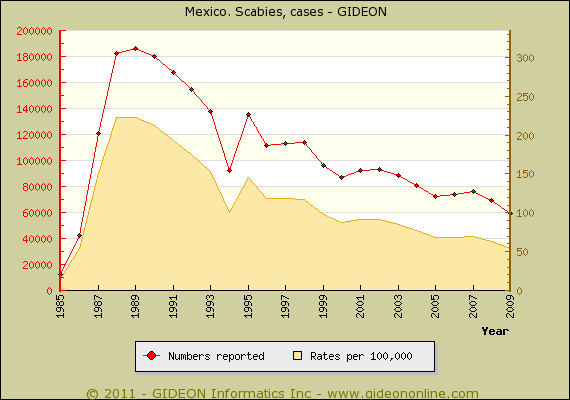
Mexico is one of relatively few countries which publish rates of scabies on a national level. A recent outbreak in Veracruz belies the fact that infestation rates have been steadily declining since the 1980’s (see graph). [1,2]

References:
1. Berger SA. Infectious diseases of Mexico, 2011. 446 pp, 128 graphs, 1655 references. Gideon e-books, https://www.gideononline.com/ebooks/country/infectious-diseases-of-mexico/
2. Berger SA. Arthropod Infections: Global Status, 2011. 85 pp, 70 graphs, 242 references. Gideon e-books, https://www.gideononline.com/ebooks/disease/arthropod-infections-global-status/

Featured in ProMED

Botulism in France

The following background data on botulism in France are abstracted from Gideon www.GideonOnline.com and the Gideon e-book series. [1,2]

Time and Place:
– Botulism has been a notifiable disease in France since 1986.
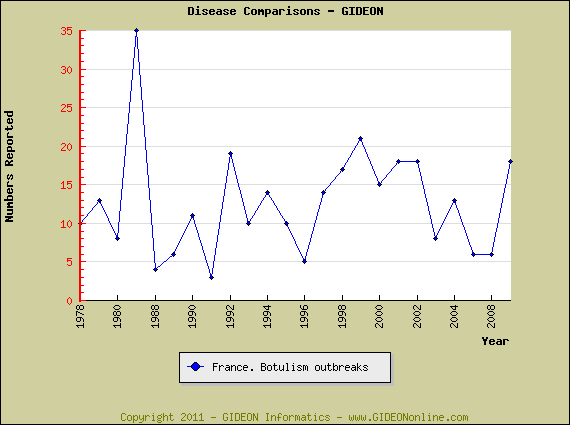
– The yearly number of outbreaks has changed little during the past thirty years [see graph] [3]
– 56% of outbreaks during 1993 to 1996 were ascribed to ham products; 69% during 2001 to 2002.
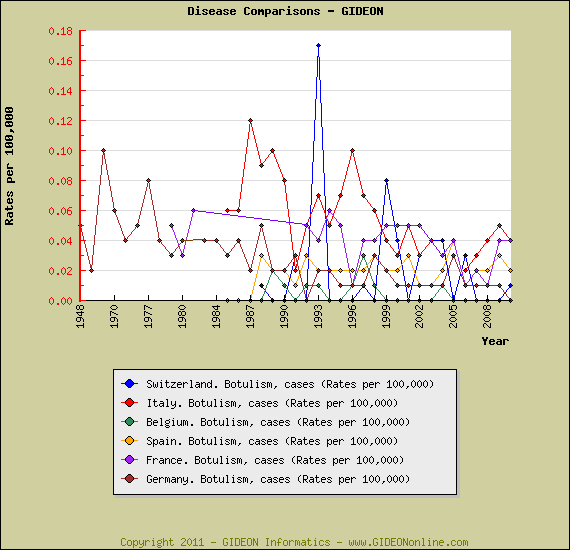
– Annual botulism rates vary from 0.01 to 0.04 per 10,000, and are similar to rates reported in surrounding countries [see graph]
– 51 fatal cases were reported during 1956 to 2002
– 2 cases of infant botulism (both type B) were reported during 1983 to 2006; 7 (0 fatal) during 1991 to 2009; 1 per year from 2004 to 2008; 2 in 2009

Year(s) / Outbreaks / Cases / Deaths
1875 to 1939 / NA / 24 / 3
1940 to 1944 / 500 / 1,000 / NA
1945 to 1948 / 85 / NA / NA
1950 to 1954 / 5 / 26 / 2
1956 to 1970 / 134 / 337 / 17
1971 to 1980 / 290 / 621 / 16
1981 to 1990 / 170 / 293 / 12
1991 to 2000 / 142 / 278 / 5
2003 to 2006 / 56 / 96 / NA

Clostridium botulinum types:
– 87% of botulism cases reported during 1991 to 2000 were due to type B Clostridium botulinum, 6% type A and 6% type E.
– All cases reported during 1991 to 1996 were due to type B Clostridium botulinum, with highest incidence in the central region.
– 63 of 78 outbreaks reported during 1997 to 2002 were due to type B toxin.
– 16 cases of type E botulism were reported during 1952 to 1999.

In two cases, botulism was associated with inhaled cocaine.

Notable outbreaks:
1978 – An outbreak (31 cases, 0 fatal) of type B botulism was caused by contaminated soft cheese.
2000 – An outbreak (9 cases, 0 fatal) of type B botulism was caused by contaminated home-canned asparagus.
2001 (publication year) – An outbreak (3 cases, 0 fatal) of type B botulism was reported among members of a family.
2003 – An outbreak (4 cases, 0 fatal) of type B botulism involving two departments was caused by contaminated halal sausage.
2008 – An outbreak (2 cases, 0 fatal) of type A botulism in Brittany was caused by contaminated industrially-produced chicken enchiladas.
2009 – An outbreak (3 cases) of type E botulism in France was related to vacuum packed hot-smoked Canadian whitefish purchased in Finland.
2011 – An outbreak (8 cases) in the Vaucluse and the Somme was due to contaminated green almond tapenade.
2011 (publication year) – An outbreak (5 cases) in Corsica was related to ingestion of artisanal-produced food (canned green beans and/or salted roast pork).

References:
1. Berger SA. Infectious Diseases of France, 2011. Price: 687 pp, 286 graphs, 2159 references. Gideon e-books, https://www.gideononline.com/ebooks/country/infectious-diseases-of-france/
2. Berger SA. Botulism: Global Status, 2011. 80 pages, 86 graphs, 510 references. Gideon e-books, https://www.gideononline.com/ebooks/disease/botulism-global-status/
3. Gideon graph tool tutorial at https://www.gideononline.com/wp-content/uploads/Gideon-Graphs.pps )

Steve Berger
Geographic Medicine
Tel Aviv Medical Center
mberger@post.tau.ac.il

Note featured on ProMED

Bacillus Cereus Food Poisoning in the United States

The following background information on Bacillus cereus food poisoning in the United States is abstracted from Gideon www.GideonOnline.com the Gideon e-book series. [1] (primary references available on request)

Incidence and Prevalence:
– Bacillus cereus food poisoning accounts for approximately 2% of food-related disease outbreaks with confirmed etiology reported to CDC (United States Centers for Disease Control) .
– In one study, The estimated incidence was 27,360 cases per year (8 hospitalizations), accounting for 0.2% of all food-borne illness. A subsequent study estimated yearly incidence at 63,623 cases (2010 publication).

Year(s) / Reported outbreaks / Outbreak cases
1969 / 3 / 14
1971 / 0
1972 / 0
1973 / 1 / 2
1974 / 1 / 11
1975 / 3 / 45
1976 / 2 / 63
1980 / 9 *
1981 / 8 **
1993 to 1997 / 14 / 691
1998 to 2002 / 37 / 571
2006 / 13 / 72
2007 / 19 / 164
2008 / 15 / 122
* Included such vehicles as beef, turkey and Mexican foods
** Most involved rice and shellfish

Published outbreaks:
1976 (publication year) – An outbreak (4 cases) was associated with contaminated vegetable sprouts.
1981 (publication year) – An outbreak (4 cases) at a cafeteria was ascribed to contaminated macaroni-and-cheese.
1985 – An outbreak (11 cases) was associated with a Japanese restaurant in Maine.
1988 (publication year) – An outbreak at a Rhode Island nursing home was associated with consumption of beef stew.
1989 – An outbreak was reported at a catered wedding reception in California.
1993 (publication year) – An outbreak (139 cases) was associated with pork served at a university field day.
1993 – An outbreak among children and staff at two day-care centers in Virginia was associated with contaminated fried rice.
1998 – An outbreak (7 cases) at a church day school in Texas was ascribed to rice contaminated by handling.

References:
1. Berger SA. Infectious Diseases of the United States, 2011. 1030 pp, 464 graphs, 8237 references. Gideon e-books, https://www.gideononline.com/ebooks/country/infectious-diseases-of-the-united-states/

Note featured on ProMED

GIDEON Sign In